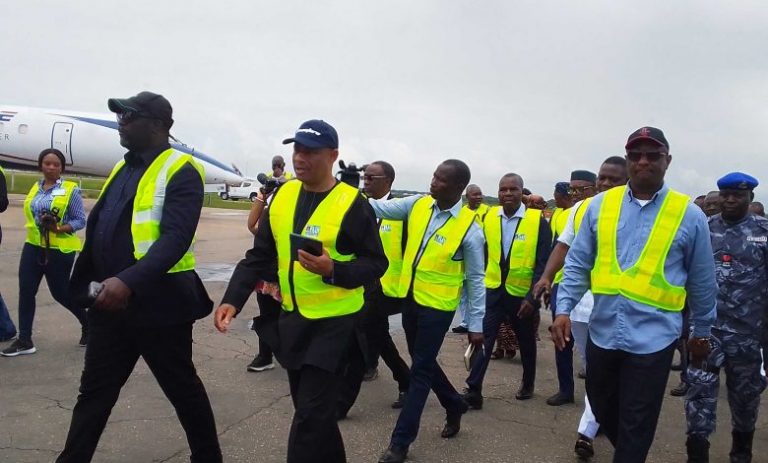
The Minister of Aviation and Aerospace Development, Festus Keyamo, on Tuesday inspected the fire-affected sections of Murtala Muhammed International Airport Terminal 1 in Lagos, confirming that operations will be relocated ahead of the building’s demolition.
Keyamo stated that Fingers D and E of the old terminal would be moved to temporary facilities to pave the way for reconstruction works. He clarified that the incident affected the old terminal already slated for demolition, not the new terminal.
Fire Damage And Emergency Response
The fire impacted airline counters, offices, and equipment belonging to the Nigerian Airspace Management Agency (NAMA) and the Nigerian Meteorological Agency (NiMet).
According to the minister, several air traffic controllers were trapped on upper floors and had to be rescued using cranes. He commended first responders, including the Lagos State Fire Service and Federal Airports Authority of Nigeria personnel, for preventing casualties and containing further damage.
“We thank God there was no loss of life,” Keyamo said, describing that as the foremost relief in the aftermath of the incident.
Demolition Plans Already Underway
The minister disclosed that plans to decommission and demolish the ageing terminal had been in motion prior to the fire outbreak. He explained that evacuation arrangements were already ongoing, with airlines and agencies preparing to move into temporary structures provided by the Chinese construction firm handling the new terminal project.
He noted that while the building was due to be pulled down, critical equipment—particularly meteorological and air navigation systems—suffered significant damage.
“It is still unsafe to access certain upper floors,” he said, adding that the fire would accelerate the transition process.
Flight Operations To Continue
Keyamo assured airlines and the international community that flight operations would not face prolonged disruption. Temporary air traffic control facilities have been deployed, with mobile control towers expected to restore full operational capacity.
He emphasised that the Lagos airport handles approximately 67 per cent of Nigeria’s international passenger traffic, underscoring its strategic importance as the country’s primary aviation gateway.
Vision For A Regional Hub
The minister reiterated the Federal Government’s long-term objective of transforming MMIA into a competitive regional transit hub capable of challenging other West African and African aviation centres.
He said the redesign would enable seamless passenger transit without requiring entry visas, positioning Nigeria as a key aviation connector on the continent.
Keyamo concluded that the reconstruction aligns with President Bola Tinubu’s broader infrastructure renewal agenda, aimed at modernising critical national assets and enhancing Nigeria’s global competitiveness in aviation.