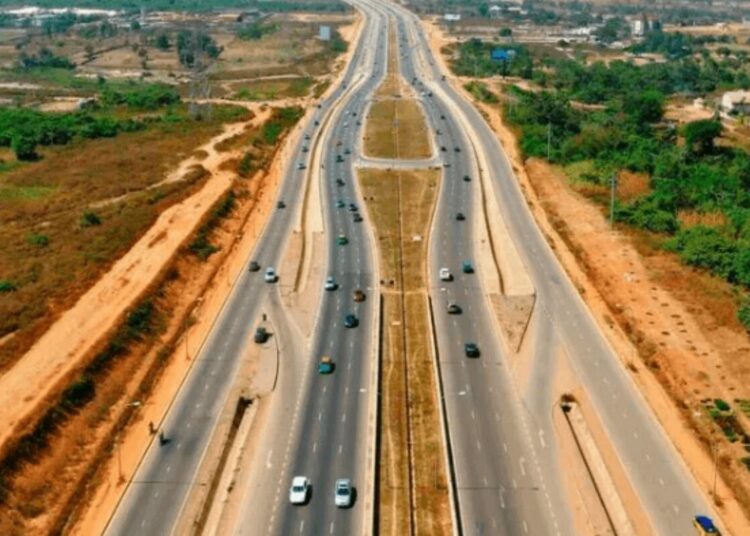
The Federal Government has said the 7th Axial Road project in Lagos will serve as a major evacuation corridor for cargo and significantly ease congestion at the Lekki Deep Sea Port and the Dangote Refinery upon completion.
Minister of Works, Dave Umahi, disclosed this during an inspection tour of ongoing construction works along the Lekki corridor, describing the road as a strategic infrastructure project designed to unlock economic growth and strengthen national logistics mobility.
According to the minister, the 7th Axial Road, located behind the Dangote Refinery, will function as a dedicated cargo evacuation route linking the Lekki industrial hub to the Sagamu corridor and other parts of the country. He said the project is central to reducing pressure on existing road networks while supporting seamless operations at the Lekki Deep Sea Port.
Strategic Economic Importance
Umahi stressed that the road, once completed, will not only ease port congestion but also deliver long-term economic benefits to Lagos State and Nigeria at large. He explained that the corridor will enhance the movement of goods, strengthen supply chains, and improve connectivity between key industrial zones.
“The 7th Axial Road is critical to the success of port operations and industrial expansion within the Lekki axis,” the minister said, noting that it complements other major infrastructure projects such as the Coastal Road and Dangote Road.
He added that the project aligns with the Federal Government’s broader agenda of modernising Nigeria’s transport infrastructure to support economic diversification and industrial development.
Unlocking Swampy Corridors
Umahi vowed to address the engineering challenges posed by the swampy terrain along the Dangote refinery route and other critical evacuation corridors. He assured that the Ministry of Works would deploy the necessary technical expertise and resources to ensure the project’s timely and durable completion.
During the inspection, the minister directed that roadbed filling works under Project Lot One must be completed by the end of April. He instructed the contractor to intensify on-site activities and scale up the deployment of manpower, equipment, and construction materials to meet project timelines.
He emphasised that tangible progress must be visible on the site and warned against delays that could undermine the strategic value of the corridor.
Confidence in Project Contractor
Umahi expressed confidence in China Harbour Engineering Company Limited (CHEC), the project contractor, citing its successful delivery of the Lekki Deep Sea Port project.
He also referenced the company’s ongoing work on the Makurdi–Enugu road reconstruction and expansion project, describing the quality of construction as satisfactory.
A representative of CHEC assured the minister of the company’s commitment to delivering the 7th Axial Road on schedule. The contractor confirmed that resources have been scaled up at the construction site, with emphasis on safety, quality control, and environmental protection.
Environmental and Safety Compliance
The Minister further called for strict adherence to environmental standards and safety regulations throughout the construction period. He urged relevant regulatory agencies to monitor compliance and ensure that ecological considerations are not compromised.
He noted that the 7th Axial Road is designed to integrate seamlessly with other major infrastructure projects within the Lekki corridor, reinforcing its position as a critical transportation and industrial hub.
Boost for National Logistics
The Federal Government maintains that the completion of the road will strengthen Nigeria’s logistics architecture by improving cargo evacuation from ports and industrial facilities. The project is expected to reduce bottlenecks, lower transportation costs, and enhance the overall efficiency of goods movement across the country.
With the rapid expansion of industrial activities in the Lekki axis, particularly around the Dangote Refinery and the Lekki Deep Sea Port, authorities say the 7th Axial Road will play a decisive role in sustaining economic momentum and attracting further investments.
As construction progresses, stakeholders in the maritime and logistics sectors are closely monitoring developments, hopeful that the project will bring lasting relief to port congestion and position Lagos as a more competitive gateway for trade in West Africa.