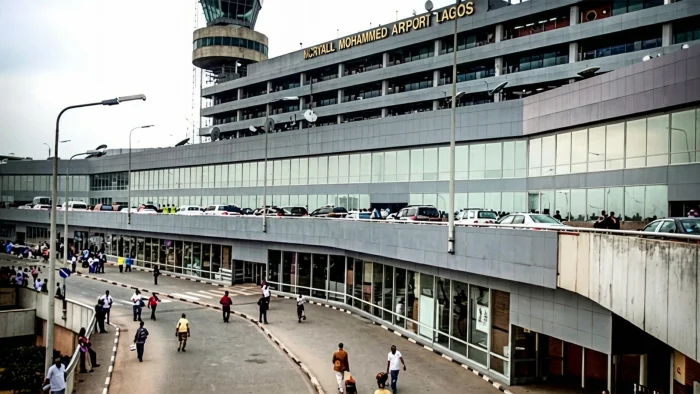
There was heavy gridlock at the tollgate of the Murtala Muhammed International Airport (MMIA) on Sunday following the enforcement of a new cashless payment policy by the Federal Airports Authority of Nigeria (FAAN).
The development led to significant traffic congestion along the access road to both the domestic and international terminals, leaving hundreds of motorists and air travellers stranded for hours.
Motorists, Passengers Caught in Gridlock
The tollgate, which serves as a major entry point into the airport complex, witnessed long queues of vehicles as drivers struggled to comply with the newly introduced cashless system.
Some passengers reportedly abandoned their vehicles and resorted to motorcycles to avoid missing scheduled flights. Ironically, commercial motorcyclists—previously restricted within the airport vicinity—took advantage of the situation, allegedly inflating fares by as much as 200 per cent.
Several motorists were said to have remained stuck in one spot for nearly 20 minutes for what is ordinarily less than a one-minute drive through the tollgate.
The congestion triggered heated exchanges between drivers and tollgate officials, with some motorists complaining of failed electronic transfers and delayed payment confirmations.
FAAN Defends Policy
FAAN’s Director of Public Affairs and Consumer Protection, Henry Agbebire, explained that the cashless initiative was introduced to block revenue leakages and curb extortion within the system.
He stated that the enforcement aligns with the Federal Government’s broader drive toward a cashless economy and improved financial transparency.
Agbebire dismissed allegations that the agency failed to adequately sensitise airport users before implementation, insisting that sufficient publicity had been carried out.
According to him, the agency had made enough prepaid access cards available to motorists. “The card is free, but when you load N2,000 or N1,000, N500 goes for maintenance,” he clarified.
Public Reaction
Some affected motorists, however, expressed frustration over what they described as poor planning and inadequate transition arrangements.
One of the stranded drivers, Adebayo Awojobi, lamented spending nearly an hour in traffic on a typically less congested Sunday. He questioned how the situation would unfold on a weekday when vehicular traffic is usually heavier.
Critics argued that while the cashless system may improve revenue accountability in the long term, its abrupt enforcement created avoidable hardship for travellers and airport users.
Revenue Drive vs Operational Readiness
Industry observers note that while digital payment systems can reduce corruption and improve efficiency, implementation in high-traffic environments such as airports requires seamless infrastructure, robust connectivity and adequate public awareness to avoid operational breakdown.
The incident underscores the delicate balance between policy reforms and on-ground readiness, especially in critical transport hubs like MMIA, Nigeria’s busiest international gateway.
As FAAN continues to enforce the policy, travellers have been advised to obtain the required access cards in advance and ensure sufficient funds are loaded to avoid delays at the airport tollgate.