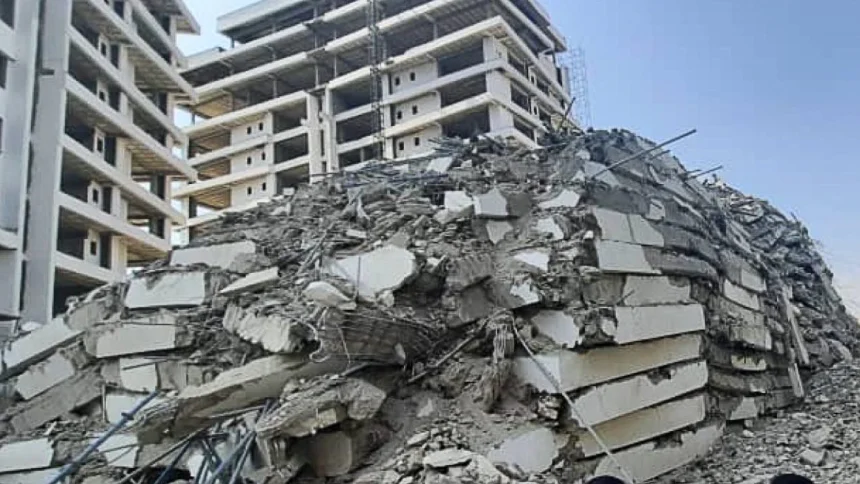
Nigeria’s persistent building collapse crisis is increasingly linked to inadequate soil testing, a critical but often neglected step in construction that experts say determines whether structures can safely stand over time.
Urban planners, engineers and construction professionals warn that without rigorous geotechnical investigations and stronger regulatory enforcement, many buildings across the country remain at risk of structural failure.
Across cities such as Lagos, Abuja and Port Harcourt, numerous building collapse incidents have occurred in recent years, claiming lives and destroying property. Experts say many of these tragedies could have been avoided if proper soil testing had been conducted before construction began.
Importance of soil testing in construction
Every building depends on a stable foundation, and the strength of that foundation is largely determined by the characteristics of the soil beneath it.
Soil testing is a scientific process used by engineers to assess the ground’s ability to support a structure’s weight while withstanding environmental pressures such as heavy rainfall, flooding, erosion and ground movement.
Without accurate soil data, engineers cannot design an appropriate foundation system, increasing the risk of uneven settlement, structural cracks and eventual collapse.
However, experts say that in many parts of Nigeria, developers sometimes skip thorough soil investigations in an effort to cut costs or speed up construction timelines.
Scale of building collapse incidents
Statistics show the severity of the problem.
According to the Building Collapse Prevention Guild (BCPG), Nigeria recorded about 679 building collapse incidents between 1971 and 2025, resulting in at least 1,639 deaths nationwide.
Lagos State accounts for more than half of these cases due to its rapid urbanisation, high population growth and intense construction activities.
Between 2022 and September 2025 alone, about 145 building collapse incidents were recorded across the country.
Experts say that while several factors contribute to structural failures, weak foundations linked to poor soil investigation remain one of the leading causes.
Developers’ negligence blamed
Investigations into many building collapse incidents have revealed that some developers bypass essential engineering procedures.
In several cases, soil investigation reports are ignored, unqualified contractors are hired, or construction decisions are made without professional engineering advice.
Experts say the pressure to complete projects quickly and maximise profits has encouraged a “build fast, sell fast” culture within parts of the real estate sector.
This approach often prioritises speed over safety, leading developers to overlook crucial technical processes such as geotechnical investigations.
However, engineers warn that soil conditions can vary significantly even within short distances, meaning that neighbouring buildings cannot be used as reliable indicators of ground stability.
Government oversight concerns
Regulatory agencies have also come under scrutiny for weak enforcement of building standards.
Building control departments in several states face challenges including inadequate staffing, limited funding and insufficient monitoring capacity.
In some cases, construction permits are issued without proper verification of soil test reports or structural designs.
Industry experts say these enforcement gaps allow unsafe construction projects to proceed without proper oversight.
They also argue that penalties for violating building regulations are often too weak to deter malpractice.
Concerns over professional capacity
Although Nigeria has many qualified geotechnical engineers, experts say some professional firms lack modern equipment or adequate technical capacity for comprehensive soil testing.
There have also been allegations of fabricated reports or “table-top” soil investigation results produced without proper site testing.
Such practices undermine professional standards and compromise the reliability of engineering designs.
Human and economic consequences
The impact of building collapse extends far beyond damaged structures.
Lives are lost, families are displaced and communities face long-term trauma after such incidents.
Financial losses from collapsed buildings can run into billions of naira, while repeated disasters continue to weaken public confidence in Nigeria’s construction and real estate sectors.
Experts say strict adherence to professional standards, proper soil testing and stronger regulatory oversight are essential to preventing future tragedies.
Calls for stricter compliance
President of the Building Collapse Prevention Guild, Sulaimon Yusuf, said soil testing is commonly carried out for major infrastructure projects but is often ignored in smaller residential developments.
He explained that while high-rise buildings and government projects usually undergo rigorous geotechnical investigations, many privately built houses bypass the process.
According to him, developers often see soil testing as an unnecessary expense rather than a safeguard against structural failure.
Yusuf called for stricter enforcement of building regulations, including a mandatory “No Soil Report, No Development Permit” policy for all construction projects.
Structural engineers warn of foundation risks
Former President of the Nigerian Institution of Structural Engineers, Dr Victor Oyenuga, said failure to conduct soil testing significantly increases the likelihood of structural collapse.
He noted that the cost of soil testing is relatively small compared to the overall construction budget.
Oyenuga explained that even in large projects worth billions of naira, the cost of soil investigation typically represents only a tiny fraction of total project expenses.
He warned that in coastal areas such as Lekki in Lagos or parts of Port Harcourt where soils are soft and waterlogged, soil testing becomes even more critical.
Regulatory framework gaps
Civil engineering expert Dr Omolola Adetona also highlighted the absence of a unified national standard requiring soil testing for all building projects in Nigeria.
According to her, requirements vary across states and are often poorly enforced, leaving the decision largely to developers and contractors.
She noted that while large commercial developments usually conduct soil investigations, smaller residential projects frequently bypass the process.
Construction practices also contribute
Another engineer, Dr Aji Tijani, said poor construction practices can also lead to structural failure even when soil conditions are favourable.
He explained that some contractors alter approved engineering designs to reduce costs by changing the concrete mix, using reinforcement bars of the wrong size or reducing structural supports.
Other factors that weaken buildings include the use of unsuitable water for concrete mixing, poor supervision during construction and unauthorised modifications such as adding extra floors.
Experts maintain that addressing Nigeria’s building collapse crisis will require stronger enforcement of construction regulations, improved professional standards and widespread awareness of the importance of proper soil testing in building projects.
Alt text: Collapsed building site in Lagos highlighting structural failure
Caption: Experts say poor soil testing is a major cause of building collapse in Nigeria
Description: Engineers and construction experts warn that inadequate soil testing and weak regulation continue to fuel Nigeria’s recurring building collapse crisis.