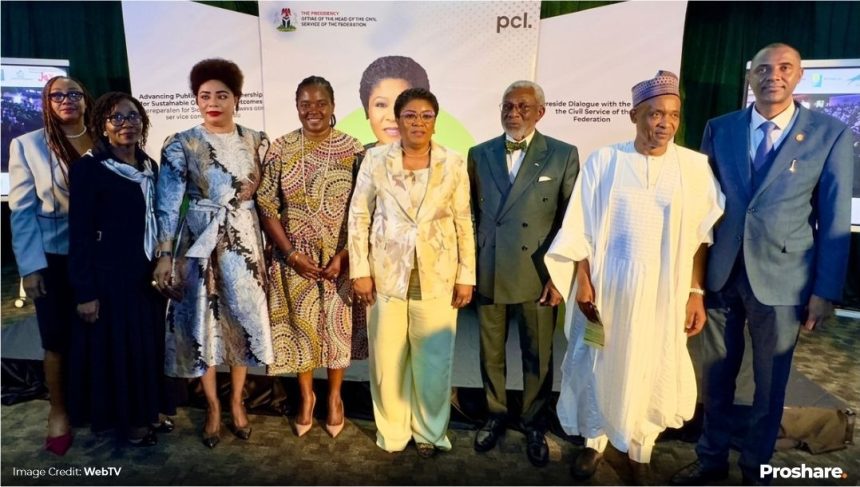
Stakeholders across Nigeria’s public and private sectors have renewed calls for stronger collaboration to accelerate sustainable development and economic growth.
The call was made during a fireside chat and breakfast session with the Head of Service of the Federation, Mrs. Didi Esther Walson-Jack, themed “Advancing Public-Private Partnership for Sustainable Governance.”
The event, organised by the Office of the Head of Service of the Federation in collaboration with Philips Consulting Limited, brought together senior government officials and private sector leaders to explore ways of strengthening governance and boosting national productivity.
In his opening remarks, Chairman of Philips Consulting, Foluso Phillips, described the gathering as a critical meeting point for aligning public service goals with private sector expectations.
“No country grows sustainably without a strong public service, and no economy thrives without a vibrant private sector. Alignment between both is essential,” he said.
Phillips noted that the platform enabled both sectors to share ideas, align priorities, and shape policies that can drive transformational impact on Nigeria’s economy.
Speaking at the event, Mrs. Walson-Jack said ongoing reforms are repositioning the Federal Civil Service to become more efficient, transparent, and business-friendly.
She highlighted improvements in regulatory processes, service delivery speed, and digital transformation, noting that these changes are designed to support businesses and improve citizens’ quality of life.
“In today’s Civil Service, we are seeing predictable regulations, faster processes, and improved efficiency. These reforms will impact infrastructure, healthcare, digital inclusion, and justice delivery,” she said.
The Head of Service also revealed that the government is leveraging emerging technologies, including a Service-Wide GPT platform, to enhance access to key policy documents and improve decision-making across Ministries, Departments, and Agencies.
She added that initiatives such as performance management systems, personnel audits, and skills gap analysis are being implemented to build a world-class Civil Service capable of driving national development.
Addressing concerns from private sector leaders, Walson-Jack assured that staff welfare and working conditions, including housing and transportation, are under review to attract and retain talent.
She further disclosed that the upcoming International Civil Service Conference, scheduled for May 20–21, 2026, will provide another platform to deepen public-private collaboration.