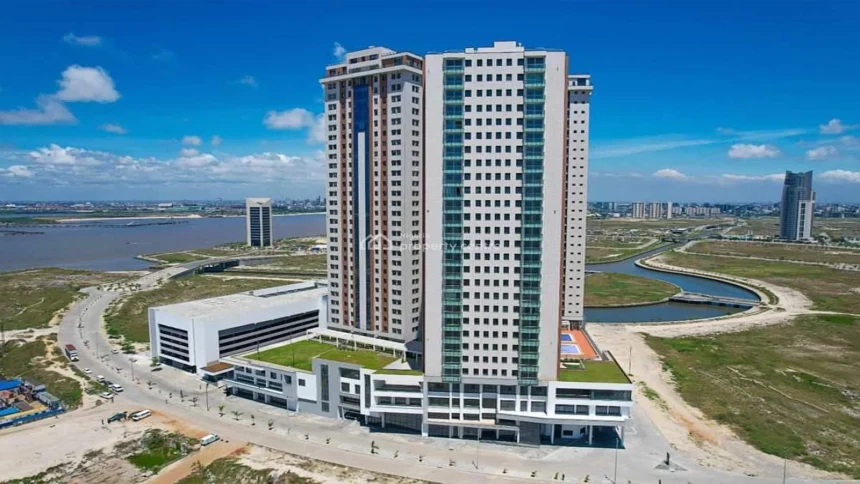
Nigeria’s urban landscape is undergoing a dramatic transformation as developers increasingly embrace high-rise buildings to cope with rising population pressure, land scarcity and growing demand for residential and commercial spaces.
Across major cities such as Lagos, Abuja and Port Harcourt, tall residential towers, office complexes and mixed-use developments are steadily replacing the low-rise structures that once dominated urban development.
Industry experts say the shift toward vertical development is being driven by rapid urbanisation, soaring land prices, housing shortages and the need to maximise limited space in prime locations. However, they warn that weak infrastructure, poor maintenance culture and inadequate regulatory enforcement could threaten the sustainability of the trend if urgent reforms are not implemented.
Nigeria’s Urban Population Pressure
With Nigeria’s population projected by the United Nations to reach nearly 400 million by 2050, pressure on urban centres continues to intensify. Lagos alone reportedly receives about 6,000 new residents daily as people migrate into the city in search of economic opportunities.
The increasing population has placed enormous strain on housing, transportation, electricity, drainage systems and other urban infrastructure. Nigeria’s housing deficit is estimated at between 16 million and 23 million units, leaving millions of residents in overcrowded and inadequate accommodation.
As available land becomes increasingly scarce and expensive, developers are turning to vertical construction as a practical solution for accommodating urban growth without excessive horizontal expansion.
Why Developers Are Building Upward
Urban planners describe vertical development as the construction of multi-storey residential, commercial or mixed-use buildings designed to optimise limited land resources.
Globally, countries such as the United States, China, the United Arab Emirates and Saudi Arabia have adopted skyscraper developments to manage population growth, preserve land and strengthen economic activities within cities.
In Nigeria, rising land prices have become one of the biggest factors pushing developers toward high-rise construction.
Investigations show that land in premium locations across Lagos and Abuja has become extremely expensive. In Eko Atlantic City, plots reportedly cost up to N2 billion, while land in Ikoyi, Victoria Island and Banana Island ranges from hundreds of millions to billions of naira depending on size and location.
In Abuja, plots in Maitama, Asokoro and Guzape have also witnessed massive price increases, making low-density development less economically viable.
Architect and Managing Partner of Sowunmi Williams and Associates, Sowunmi Williams, explained that developers now prefer vertical projects because they maximise land value and reduce overall cost per housing unit.
According to him, a single plot that may contain only a few bungalows can accommodate dozens of apartments if developed vertically.
“On expensive land, it becomes more economical to build upward because the cost is spread across many housing units,” he explained.
Growth Of Luxury High-Rise Projects
Findings also indicate that many private developers are now investing heavily in premium high-rise developments in areas such as Ikoyi, Victoria Island, Lekki and Eko Atlantic.
Data from real estate intelligence firm Estate Intel revealed that about 1,000 luxury residential units were delivered in Lagos between 2020 and 2025, with more projects expected in 2026.
Most of the new developments are high-rise structures targeting luxury residential and mixed-use markets.
Government housing agencies have also embraced vertical housing models in areas such as Surulere, Iponri, Adeniji Adele and Ilubirin in Lagos.
Benefits Of Vertical Development
Experts say high-rise developments offer several advantages beyond increasing housing supply.
Vertical construction helps reduce urban sprawl, preserve land and improve land-use efficiency. It also allows residential, office and recreational facilities to coexist within the same environment, reducing commuting pressure and improving accessibility.
The Managing Partner of Durarch Limited, Durojaiye Ale, said modern skyscrapers are now supported by advanced technologies such as reinforced concrete systems, smart building solutions and high-speed elevators.
According to him, vertical development has become an economic necessity for densely populated cities like Lagos.
“Building upward allows cities to accommodate more people on limited land while reducing uncontrolled expansion,” he said.
Ale also noted that high-rise developments can create additional ground space for drainage infrastructure, green areas and flood control systems, particularly in flood-prone environments like Lagos.
Concerns Over Infrastructure And Safety
Despite the growing popularity of vertical construction, experts warn that Nigeria still lacks adequate infrastructure and technical capacity to support widespread high-rise development safely.
Tall buildings require stable electricity supply, efficient water systems, proper drainage networks and reliable transportation infrastructure, many of which remain weak in several Nigerian cities.
Maintenance culture also remains a major concern, especially regarding elevators, fire systems and mechanical installations.
Industry stakeholders have raised concerns over increasing cases of elevator failures, poor emergency preparedness and weak compliance with fire safety regulations in some high-rise buildings.
Director General of the Lagos State Safety Commission, Lanre Mojola, stressed the importance of regular risk assessments and strict compliance with safety standards.
According to him, high-rise buildings must be regularly inspected to prevent accidents linked to fire outbreaks, elevator failures and structural risks.
Experts also warned that emergency evacuations from high-rise buildings are more complicated than from low-rise structures, making strict adherence to safety regulations critical.
Future Of High-Rise Development In Nigeria
Professionals in the built environment believe vertical development will continue expanding as urbanisation accelerates and land prices rise further.
However, they insist that long-term success will depend on stronger planning regulations, improved infrastructure, better safety enforcement and investment in skilled manpower.
Williams noted that high-rise construction requires highly trained professionals, advanced engineering systems and strict regulatory oversight.
“The challenge with vertical development is that you need highly skilled professionals to handle the projects safely. Fire safety and maintenance are also critical issues,” he said.
Ale added that only a limited number of contractors in Nigeria currently possess the technical expertise required for very tall structures, particularly projects exceeding 50 floors.
He also warned that high-rise buildings come with high energy demands due to elevators, cooling systems and backup power requirements.
According to him, Nigeria must strengthen infrastructure and institutional capacity to ensure vertical development remains sustainable and safe for residents.