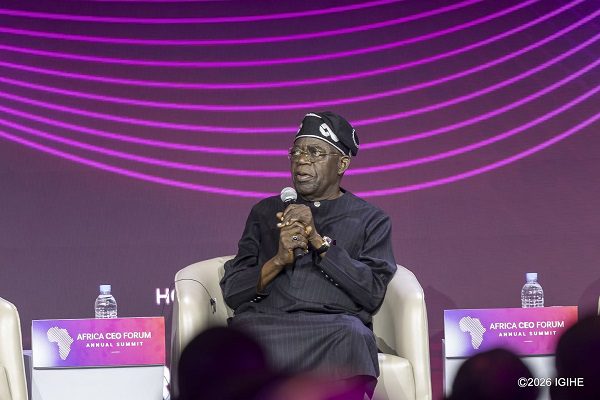
President Bola Ahmed Tinubu has revealed that Nigeria attracted nearly $20 billion in foreign direct investments (FDI) this year, attributing the inflow to reforms introduced by his administration to improve transparency, efficiency and investor confidence.
Speaking during a panel session at the ongoing Africa CEO Forum, President Tinubu said the government’s economic reforms are gradually positioning Nigeria as a more attractive and competitive destination for investors.
“In Nigeria, we’ve attracted nearly $20 billion in direct investment this year because we are efficient, transparent and open for business,” the President said.
Tinubu Pushes Local Value Addition for Mineral Resources
The President stressed that Nigeria would no longer support the export of raw minerals without domestic value addition, noting that the country possesses the capacity to process mineral resources into finished products.
He specifically pointed to opportunities in electric vehicle manufacturing, stating that Nigeria has the resources required to produce batteries and support industrial growth.
“With our metals, we can produce batteries for cars. The private sector brings capital and expertise, but government must de-risk and create the enabling environment,” he said.
Tinubu explained that stronger collaboration between government and investors remains critical to accelerating development across Africa.
President Calls for Full Implementation of AfCFTA
The President also urged African countries to move beyond discussions and fully activate the African Continental Free Trade Area (AfCFTA).
According to him, African nations must work together and maximise the continent’s resources rather than operating in isolation.
“We have the African Continental Free Trade Area—it must not sit on the shelf. It needs to be activated properly through collaboration and effective use of resources,” Tinubu said.
He advocated an “Africa First” development strategy that prioritises local production, processing and manufacturing.
“We don’t want scavengers and extractors. We want partners who process and manufacture locally,” he added.
Dangote Refinery Shows Africa Can Deliver Large Projects
Tinubu cited the success of the Dangote Refinery as evidence that African nations can execute large-scale industrial projects when supported with the right policies.
According to him, Nigeria’s transition from dependence on imported petroleum products to becoming a net exporter demonstrates the impact of strategic government support.
“Today Nigeria is a net exporter of PMS, aviation fuel and other products. Dangote is supplying aviation fuel across Africa and to European airlines,” he said.
Tinubu Calls for African Financial Reforms
The President also questioned Africa’s continued dependence on foreign currencies for trade transactions.
He argued that conducting trade using local currencies would reduce costs and improve economic stability across the continent.
“If you produce in Nigeria, you can trade in naira. Why should African trade depend on dollars? That adds cost and instability,” he said.
Tinubu proposed an African commodity exchange platform that would allow direct trade among African countries.
He further called for the establishment of an African credit rating agency, arguing that many international rating firms do not properly understand African economic realities.
“The big American agencies dominate 95 per cent of the market, but they don’t understand our risks and opportunities,” he stated.
Nigeria Expands Digital Infrastructure
On digital development, Tinubu disclosed that Nigeria is currently laying 19,000 kilometres of fibre optic cables nationwide to improve connectivity and strengthen the digital economy.
He noted that Africa must move beyond basic telecommunications and begin investing in broader digital systems, including artificial intelligence, e-commerce, and data infrastructure.
“We need to fund Africa’s shift from basic telecoms to AI and e-commerce,” he said.
The President expressed optimism that despite current challenges, stronger cooperation and commitment among African nations would eventually drive greater economic integration.
“Pan-Africanism can’t remain a slogan. It has to be lived,” he said.