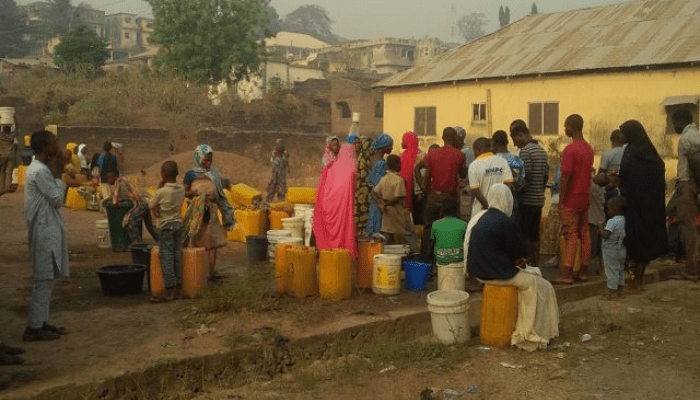
Residents and businesses across the Federal Capital Territory (FCT) continue to face severe water shortages despite billions of naira invested in water infrastructure projects, forcing many households in Abuja to rely on boreholes, water tankers and vendors for daily supply.
Findings show that rapid urbanisation, aging infrastructure, incomplete transmission networks, climate pressures, operational inefficiencies and governance challenges are driving the persistent crisis.
Over ₦155 billion has reportedly been committed to water projects in the FCT, including the $470 million (about ₦65 billion) Greater Abuja Water Supply Project and the rehabilitation of the Phase II Water Treatment Plant at the Lower Usuma Dam.
Other projects include the ₦90 billion Bwari Township Water Supply Project, alongside rural water expansion schemes across FCT Area Councils supported through Chinese financing and UNICEF partnerships.
Despite these investments, large parts of Abuja still experience unreliable water supply.
Former Executive Director of the FCT Rural Water Supply and Sanitation Directorate, Mohammed Dan-Hassan, said infrastructure development has not matched the pace of population growth and urban expansion.
He noted that migration, insecurity and rapid settlement growth have placed increasing pressure on existing water systems across the territory.
“The rate of influx is not commensurate with the rate of development. People flood the capital territory, and it is overstretching the available facilities,” he said.
According to him, while treatment plants at the Lower Usuma Dam have significant production capacity, distribution remains the biggest bottleneck.
He explained that water production cannot translate into effective supply due to incomplete transmission pipelines to expanding districts.
“You can produce water, but where will you take it to?” he asked.
The Greater Abuja Water Supply Project, largely executed by Chinese contractors, is expected to extend trunk pipelines and transmission systems to underserved areas along the Airport Road corridor and satellite towns such as Lugbe, Lokogoma and Karsana.
However, many of these communities remain outside the central water network pending completion of transmission lines, reservoirs and service connections.
As a result, many residents have turned to groundwater through private boreholes, a development experts warn may pose long-term environmental and health risks due to limited regulation and water quality monitoring.
Dan-Hassan estimated that water supply coverage in the FCT currently stands between 60 per cent and 65 per cent, leaving a significant portion of residents without reliable access to pipe-borne water.
Shortages are most severe in satellite towns such as Lugbe, Kubwa, Nyanya, Gwagwalada, Sauka and Goza, where residents report prolonged periods without public water supply.
In several communities, households spend thousands of naira weekly purchasing water from vendors.
A resident of Aco Estate, Aisha Musa, described the situation as “suffering in silence,” while others warned of increased health risks from dependence on shallow wells and unregulated boreholes.
Experts also cited illegal connections to trunk pipelines as a major factor affecting distribution efficiency, reducing water pressure before it reaches reservoirs and end users.
Vandalism and tampering with infrastructure have further increased maintenance costs and disrupted supply systems.
Climate variability is also compounding the crisis, with reduced rainfall and sedimentation affecting storage capacity at the Lower Usuma Dam. Authorities have introduced inter-basin water transfer from the Gurara Dam in Kaduna State to supplement supply during dry periods.
Groundwater levels are also declining, with experts noting that borehole drilling depths have increased significantly over the past two decades due to reduced recharge rates linked to climate change.
Water governance expert and National Coordinator of the Society for Water and Sanitation (NEWSAN), Attah Benson, said the crisis reflects long-standing institutional and management challenges.
“The issue of water shortage in the FCT has been a long one. Government keeps making excuses, but citizens cannot live without water,” he said.
He warned that continued shortages expose residents to unsafe water sources, disease outbreaks, productivity loss and rising healthcare costs, with women and children most affected due to the burden of water collection.
BusinessDay findings also revealed operational challenges within the FCT Water Board, including irregular billing, system limitations and difficulties in accessing customer records.
Officials reportedly attributed some of the challenges to procurement delays, shortages of treatment chemicals and outstanding electricity debts affecting water facilities.
Experts say while rehabilitation and expansion projects are ongoing, meaningful improvement will depend on faster infrastructure delivery, stronger institutional coordination and better protection of water assets.
Without urgent intervention, they warn that the gap between water demand and supply in Abuja may continue to widen despite ongoing investments.