


By: Dr. Abel Owotemu
Africa stands at a crossroads: home to the world’s youngest population, immense natural wealth, and vibrant entrepreneurial energy—yet burdened by repeated failures of collective action.
Against this backdrop, Dr. Abel Owotemu, today unveiled his new book “The Fragmentation Paradox: Why Africa Fails at Collaboration — The Pitfalls of Going Alone & The Perils of Going Together” the 2nd installment in the Paradox series to mark Africa Day celebrations 2026 in Abuja, Nigeria.
The book confronts Africa’s paradox with clarity and urgency. Blending first‑hand observation with rigorous political economy analysis, Owotemu traces why ambitious projects—regional trade, shared infrastructure, collective security—so often falter.
He reveals how colonial borders, extractive institutions, elite capture, and external distortions undermine cooperation, while pan‑African rhetoric collapses under sovereignty anxieties and competing agendas. Far from despair or platitude, The Fragmentation Paradox offers a blueprint for reform, arguing that collaboration must be engineered through credible institutions, transparent financing, enforceable dispute resolution, and inclusive civic culture.
Case studies from regional economic blocks, the AU, Africa focused FI’s and AfCFTA illustrate both the pitfalls and the possibilities, making the book essential reading for policymakers, investors, leaders, and citizens who care about Africa’s future—not because it offers easy answers, but because it provides a clear diagnosis and a practical compass for building durable cooperation.
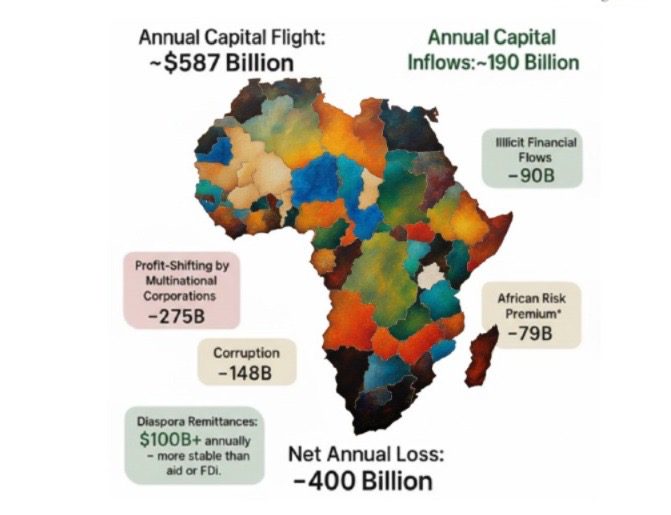
Dr Abel frames Africa’s challenge in stark financial and infrastructural terms: negative capital extraction of $400 billion annually.
Hidden inside that headline number are the building blocks of a different future. Roughly $275 billion is lost through profit shifting, $148 billion siphoned via corruption, and $90 billion drained through illicit financial flows.
Redirecting even a modest share of these outflows could transform the continent’s development ledger overnight—building thousands of schools and hospitals, electrifying cities with resilient grids, and seeding the startups and small firms that will define Africa’s twenty‑first‑century economy.
The book points to remittances as living proof of African commitment. More than $100 billion flows home each year, a countercyclical lifeline that sustains households, fuels local commerce, and demonstrates a deep, transnational willingness to invest back home.
Dr Abel argues that if diaspora transfers can be mobilized at scale for consumption and microenterprise, it can also be structured for systemic long‑term investment needs.
Repositioning Africa from a “global Africa” perspective, he contends, requires leveraging trade and services on the back of accessible migration within the continent. Key focus areas include clean and renewable energy, technology through AI and fintech, logistics and e‑commerce, healthcare and pharmaceuticals, manufacturing, and social infrastructure development.
With growing AI adoption driving local manufacturing and interlinked infrastructure, Africa stands the chance of expanding its GDP fivefold annually from 2025–2030, and exponentially thereafter every year by tenfold with steady collaboration under AfCFTA—toward a $20–$22 trillion continental economy by 2050.
Speaking about the book release, Dr Abel emphasized that “Africa’s fragmentation is not destiny. With credible institutions, transparent financing, and inclusive civic culture, collaboration can be engineered. This book is a call to action for leaders and citizens alike.”