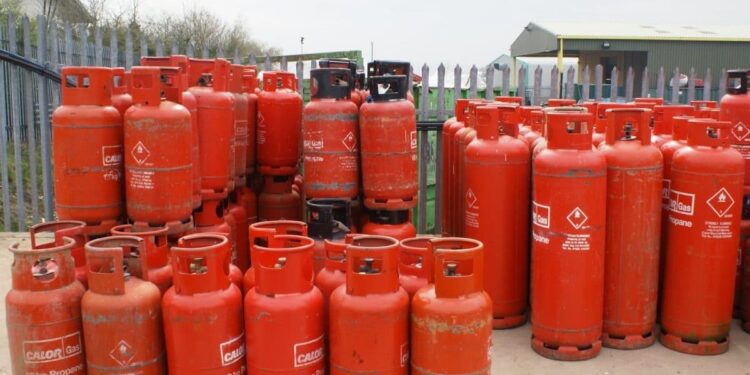
The Nigerian Association of Liquefied Petroleum Gas Marketers (NALPGAM) has projected that the retail price of cooking gas could fall to between N900 and N1,100 per kilogram by the end of 2026 if the federal government implements reforms aimed at boosting supply and reducing costs across the value chain.
President of NALPGAM, Mr. Edu Inyang, made the projection during an interview with the News Agency of Nigeria (NAN) in Lagos, noting that although Nigeria has recorded significant growth in local Liquefied Petroleum Gas (LPG) production, persistent supply chain challenges continue to keep prices elevated.
According to him, cooking gas, which sold for between N900 and N1,000 per kilogram in April, currently costs between N2,000 and N2,500 per kilogram in many parts of Lagos.
Inyang disclosed that Dangote Refinery and Nigeria LNG (NLNG) supplied about 87 per cent of Nigeria’s domestic LPG market in 2025. However, he explained that Dangote Refinery later clarified that much of its LPG output was earmarked for the production of higher-value products rather than the domestic cooking gas market, resulting in supply disruptions.
He noted that despite increased local production, several producers are still operating below installed capacity, leaving rising consumer demand unmet.
According to him, inadequate storage facilities, high transportation costs, foreign exchange challenges and multiple handling charges within the supply chain remain major contributors to high retail prices.
He further observed that LPG storage infrastructure is concentrated mainly in Lagos, the Edo/Delta axis and Port Harcourt, resulting in higher distribution costs, especially for northern states.
“Local production growth is encouraging, but consumers will not fully benefit unless bottlenecks in logistics, depot capacity, trucking and market access are addressed,” Inyang said.
The NALPGAM president also identified speculative trading, excessive intermediary margins and temporary product hoarding as factors contributing to periodic price distortions and artificial scarcity.
To improve affordability, he called for stronger market surveillance, greater transparency in product allocation and pricing, and stricter enforcement of fair competition across the LPG value chain.
Among the reforms proposed by the association are prioritising domestic LPG supply over exports, improving access to foreign exchange, reducing regulatory bottlenecks, expanding clean cooking support programmes, investing in storage infrastructure and introducing tax incentives for investors.
“With adequate domestic supply, improved infrastructure, exchange-rate stability and supportive government policies, the industry can achieve a more affordable and stable pricing environment,” Inyang stated.
He, however, cautioned that the projected price range should be viewed as a target rather than a guarantee, as global energy prices and exchange rate fluctuations would continue to influence the market.
Meanwhile, the federal government has assured Nigerians that LPG supply remains stable despite recent increases in cooking gas prices.
Minister of State for Petroleum Resources (Gas), Ekperikpe Ekpo, attributed the price surge to foreign exchange volatility, rising logistics costs, infrastructure limitations and movements in international LPG prices.
He reiterated the government’s directive that all LPG produced in Nigeria should first be prioritised for domestic consumption before exports, describing the policy as critical to improving local availability and reducing import dependence.
Ekpo also directed the Nigerian Midstream and Downstream Petroleum Regulatory Authority (NMDPRA) to strengthen collaboration with industry stakeholders to improve supply coordination and prevent market disruptions.
Data from the National Bureau of Statistics (NBS) shows that the average price of refilling a 5kg cylinder rose by 13.73 per cent from N7,655.73 in March to N8,706.93 in April, while the average cost of refilling a 12.5kg cylinder increased by 13.89 per cent from N19,652.83 to N22,382.20 during the same period.
Industry stakeholders maintain that with sustained reforms, improved infrastructure and increased domestic production, Nigeria’s LPG market could witness greater stability and more affordable prices for consumers in the coming years.