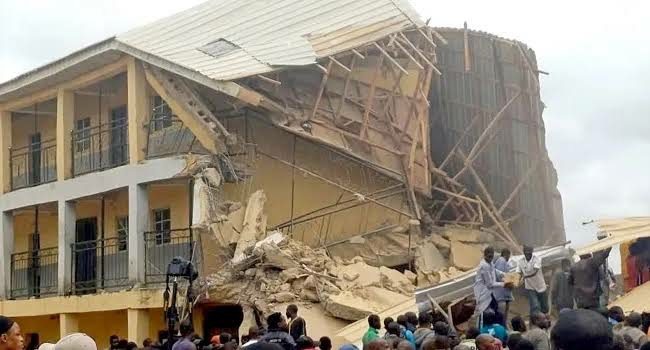
The Council for the Regulation of Engineering in Nigeria (COREN) has launched an investigation into the recent building collapse in the Gaduwa District of the Federal Capital Territory (FCT), Abuja, promising sanctions against any individuals or organisations found responsible.
The Registrar of COREN, Prof. Okorie Uche, disclosed this during an interactive session with journalists and stakeholders in Durumi 3, near Gudu Market, Abuja.
According to him, an investigative panel has already been constituted to determine both the immediate and remote causes of the collapse, with work expected to begin within the next two weeks.
He said the probe will also identify all engineers, contractors, and developers linked to the project for appropriate regulatory action.
Preliminary findings, he noted, have already revealed discrepancies regarding the identity of the engineer initially linked to the project.
“We have been able to establish that the person being paraded as the engineer on the site is not the actual person responsible,” he said.
Prof. Uche explained that although the individual named on the project signage is an engineering personnel, he is not a registered engineer qualified to act as a consultant on such a project.
He further clarified that the engineering profession operates within defined cadres, including engineers, technologists, technicians, and craftsmen, stressing that only registered engineers are legally permitted to serve as consultants on construction projects.
“The engineering profession consists of four cadres — engineers, technologists, technicians and craftsmen — but only a registered engineer can legally function as a consultant on this type of project,” he stated.
The COREN registrar also revealed that the registration number displayed on the project belongs to a different individual identified as an engineering technologist, prompting the council to summon both parties for clarification.
He added that the consultant whose name appeared on the site claimed to have withdrawn from the project earlier in May.
According to him, COREN will carefully review all submissions before reaching a conclusion, adding that all involved parties will be subjected to professional scrutiny.
Prof. Uche blamed some developers for bypassing regulatory processes and engaging unqualified personnel, warning that such practices compromise public safety.
He also raised concerns about the widespread use of substandard building materials in Nigeria, noting that many imported products fail to meet required engineering standards.
According to him, laboratory tests on materials from the collapsed structure revealed that the concrete strength was below specification.
“The concrete was expected to attain a strength of 25 newtons per millimetre square, but when tested it was only 18,” he said.
He also alleged that reinforcement rods in the market are often mislabelled, creating serious structural risks for buildings nationwide.
“You may see a reinforcement rod labelled Y-16, but when measured it is actually Y-14,” he explained.
Prof. Uche called for stronger collaboration between COREN, the Abuja Metropolitan Management Council, and the Standards Organisation of Nigeria to curb recurring building failures.
He also acknowledged funding constraints facing the council following its defunding in 2023, noting that this has affected operations into 2026.
Despite the challenges, he reaffirmed COREN’s commitment to strengthening engineering regulation and reducing building collapses across the country.