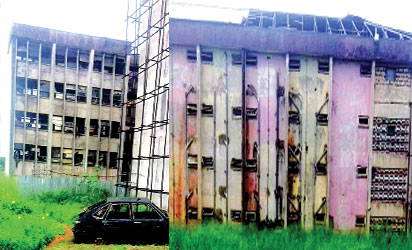
With student populations surging across Nigerian tertiary institutions, the struggle for decent accommodation has become one of the biggest challenges facing students nationwide. From universities to polytechnics, thousands of students battle yearly for limited bed spaces, forcing many to seek costly alternatives outside school campuses.
At the University of Lagos (UNILAG), with a student population exceeding 40,000, available hostel spaces remain far below demand. Only about 8,000 bed spaces exist, leaving many students scrambling for accommodation.
The situation is similar at Yaba College of Technology (Yabatech), where over 20,000 students compete for approximately 2,600 bed spaces. This year, the challenge became more difficult after one hostel containing around 1,000 bed spaces was shut down for renovation and upgrade works.
Across many Nigerian institutions, accommodation shortages continue to place pressure on students and parents alike. While private hostel developments have emerged around campuses, many students complain that rents remain beyond their reach.
To address the growing crisis, the Federal Government has launched an ambitious intervention programme through collaboration among the Tertiary Education Trust Fund (TETFund), the Federal Ministry of Education, tertiary institutions, and private developers.
The initiative, expected to gulp about N250 billion this year alone, aims to deliver modern hostel facilities through partnerships designed to increase student housing capacity nationwide.
Speaking during groundbreaking ceremonies at Lagos State University (LASU) and Yabatech, Minister of Education Dr. Tunji Alausa explained that the projects would operate under a Build-Operate-Transfer (BOT) model.
According to him, the government has earmarked N100 billion to build 500-bed student hostels across more than 50 tertiary institutions.
He also disclosed plans for 24 Public-Private Partnership (PPP) hostels with capacities ranging between 1,200 and 1,500 bed spaces in selected institutions across the country.
Under the arrangement, TETFund will contribute N1 billion while private investors provide N3 billion for each project, bringing total funding per development to N4 billion.
The minister stated that the PPP initiative alone represents approximately N96 billion in investments.
Beyond that, government plans include another N1 billion allocation for hostel projects expected to provide at least 300 bed spaces in an additional 24 institutions.
Combined together, Alausa said the projects amount to roughly N250 billion in investments dedicated to delivering modern accommodation facilities.
He said:
“We are spending about N250 billion in 2026 alone to deliver world-class, high-standard student hostels across federal and state tertiary institutions.”
The minister noted that the government intends to fast-track implementation so students can begin benefiting as quickly as possible.
According to him, PPP hostels are expected to be completed within 24 months, while several other projects have delivery timelines of less than one year.
He further revealed that hostel expansion forms part of a broader presidential education agenda executed through TETFund.
The agenda also includes:
- Rehabilitation of existing hostels
- Upgrading lecture theatres and classrooms
- Construction of new learning facilities
- Rehabilitation of engineering workshops
During the ceremony for LASU’s proposed 1,500-bed hostel project, Alausa stressed that the new facility would meet international standards while helping reduce accommodation shortages.
The Vice Chancellor of LASU, Prof. Ibiyemi Olatunji-Bello, welcomed the intervention and described it as timely.
She noted that despite the institution having more than 85,000 students, available accommodation only serves about 7,000 students.
According to her, the new hostel will significantly improve student welfare, campus safety, and social interaction.
Student leaders also praised the intervention.
Chairman of the National Association of Nigerian Students (NANS), Joint Campus Council, Lagos Axis, Quadri Ishola Odewunmi, commended both the Education Minister and Yabatech management for taking steps to improve student accommodation.
He described the projects as a practical response to one of the most pressing issues affecting Nigerian students.
Odewunmi further urged the government to extend reforms beyond student welfare by improving conditions for lecturers and non-academic staff, stressing that educational development requires a comprehensive approach.
As institutions continue to expand admissions and student populations grow, stakeholders believe the success of these projects could provide lasting relief to one of Nigeria’s biggest tertiary education challenges.