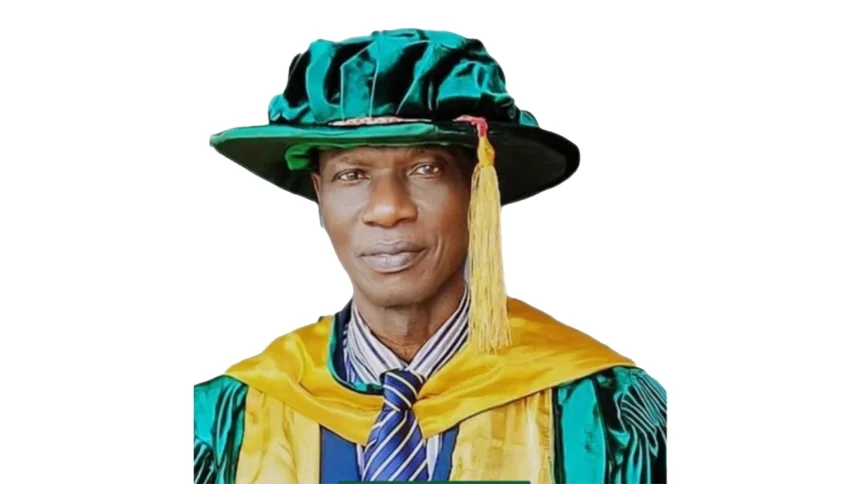
Professor of Applied Valuation at the Federal University Oye Ekiti (FUOYE), Professor Isaac Olatunji, has called for a radical transformation of Nigeria’s housing delivery system through data-driven housing choices and long-term tenancy arrangements.
Olatunji made the call while delivering the 24th inaugural lecture of the university titled “Housing Care and Support for Nigerians: Exploring the Optimality Dimension to a Critical Real Estate Decision” at the Victor Ndoma-Egba Auditorium.
The professor argued that housing delivery in Nigeria must move beyond simply providing shelter to adopting scientifically guided systems capable of improving citizens’ well-being and economic stability.
He introduced what he described as the “OPTi Revolution,” a housing decision-support framework built around the Optimality Index (OPTi), which he compared to the globally recognised Moody’s rating system.
According to him, the system uses mathematical analysis to balance income, transport costs, commuting distance, housing quality and family activity patterns in helping Nigerians make informed housing decisions.
“Just as a GPS tells you the fastest route, OPTi tells you the best utility home,” Olatunji said.
“We can keep building 700,000 houses yearly, but if we do not fix how end-users choose them and how long they can stay in them, we are simply building magnets of despair instead of magnets of hope.”
The don lamented that despite several government housing programmes over the years, poverty levels in Nigeria had continued to rise from 54.4 per cent in 2007 to an estimated 63 per cent in 2025.
He maintained that poor housing conditions and urban poverty remain closely connected.
According to findings from his research, about 65 per cent of Abuja’s vulnerable middle class are currently at risk of “housing poverty” because of hidden costs linked to poor housing choices, rising fuel prices and transportation expenses.
Olatunji further disclosed that an average middle-income family in Abuja spends between 15 and 18 months searching for suitable accommodation, describing the delay as a major drain on national productivity.
As part of his recommendations, the professor called for the institutionalisation of Residential Accommodation Procurement counselling under the supervision of the Estate Surveyors and Valuers Registration Board of Nigeria and the Nigerian Institution of Estate Surveyors and Valuers.
He urged estate surveyors and valuers to evolve from conventional house agents into professional housing procurement counsellors capable of using ICT-based tools and data analytics to guide families toward better housing decisions.
The scholar also advocated long-term tenancy arrangements ranging from 16 to 33 years, arguing that tenure security would encourage tenants to invest in housing upgrades and environmental improvements.
According to him, integrating the RAP model with long-term tenancy would create benefits for citizens, professionals and government by improving housing conditions, generating wealth and reducing urban poverty.
Olatunji also called on the Federal Government to institutionalise the OPTi Decision-Support System for public and private housing counselling as part of efforts to achieve the Sustainable Development Goals.
Reacting to the lecture, the Deputy Vice-Chancellor, Strategic Partnerships, Research, Innovation and Linkages at FUOYE, Professor Babatunde Afolabi, commended Olatunji for highlighting critical challenges affecting Nigeria’s housing sector.
Afolabi noted that the lecture identified a national housing deficit estimated at about 15 million units.
“He has been able to highlight the major challenges in the Nigerian housing industry. By his estimate and research over the years, there is about a 15 million housing deficit, which means there is a lot to be done as a nation to bridge the gap,” he said.
He expressed confidence that the recommendations from the lecture would help policymakers and stakeholders address Nigeria’s housing crisis more effectively.