


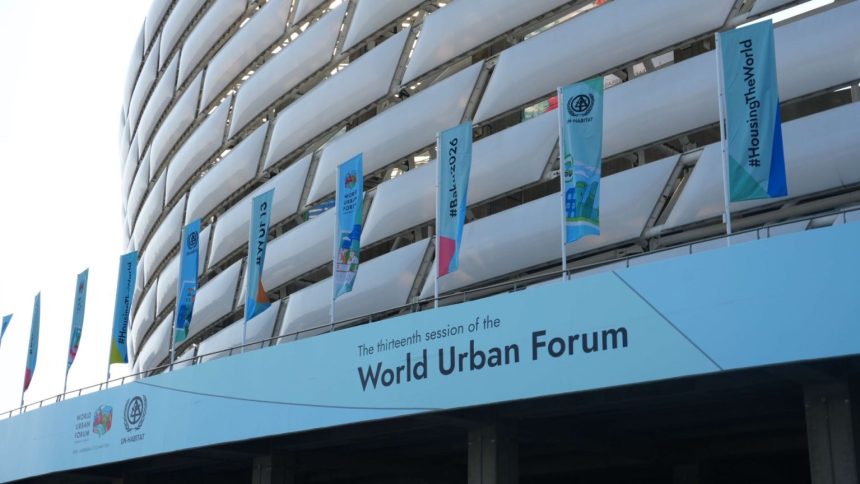
Global attention has shifted to Baku, Azerbaijan, where policymakers, urban planners, financial institutions, and housing experts are gathering for the 13th World Urban Forum (WUF13) to address escalating global housing challenges and the future of rapidly expanding cities.
Organised by the United Nations Human Settlements Programme, the forum is being held under the theme “Housing the World: Safe and Resilient Cities and Communities.” The theme reflects growing global concerns around housing shortages, climate vulnerability, informal settlements, and widening urban inequality.
The summit comes at a time when cities are facing intensified pressure from population growth, rural-urban migration, rising construction costs, environmental disasters, and economic instability. UN data indicates that billions of people still lack adequate housing, while over one billion live in slums and informal settlements with limited access to basic services such as water, sanitation, healthcare, and transport infrastructure.
Urban development experts say discussions in Baku will focus on how cities can become more inclusive, climate-resilient, and economically sustainable under mounting global uncertainty.
Africa and Nigeria Face Intensifying Urban Pressure
For developing regions, especially Africa, the housing crisis is already a daily reality rather than a policy debate. Rapid urbanisation continues to outpace infrastructure delivery, resulting in overcrowding, rising rents, traffic congestion, and environmental stress.
Nigeria, one of the world’s fastest-urbanising countries, is expected to closely follow outcomes from WUF13 as cities such as Lagos, Abuja, Kano, and Port Harcourt continue to struggle with housing deficits, informal settlements, and weak urban governance systems.
Participants are expected to evaluate how governments can balance urban renewal with social inclusion, particularly for low-income populations vulnerable to displacement and climate shocks.
Experts also argue that urban resilience must extend beyond physical infrastructure to include social protection systems, economic opportunity creation, and inclusive participation in planning processes.
Housing Finance and Climate Resilience at the Center of Debate
A key focus of WUF13 is housing finance. Many countries are grappling with inflationary pressures, expensive mortgages, and rising building material costs, which continue to push affordable housing out of reach for millions.
Delegates are expected to explore innovative financing models, public-private partnerships, and policy reforms aimed at improving affordability and expanding housing supply.
Climate adaptation is also a major priority. Increasing floods, heatwaves, and environmental disasters have exposed the vulnerability of poorly planned cities. Experts say resilient cities require stronger building codes, integrated land-use planning, improved drainage systems, renewable energy adoption, and sustainable transport systems.
The forum will also showcase global case studies on slum upgrading, smart city models, and community-driven urban renewal programmes that can be adapted in emerging economies.
Nigerian Experts Call for Inclusive Urban Planning Reform
Former President of the Association of Town Planning Consultants of Nigeria (ATOPCON), Dr Moses Ogunleye, urged governments to adopt proactive and inclusive planning systems that prevent displacement of low-income residents during urban development.
He stressed that African cities require forward-looking planning supported by sustainable financing frameworks.
Ogunleye also called for reforms in housing finance, including access to single-digit credit facilities, stronger mortgage systems, and increased private sector participation in affordable housing delivery.
He noted that Nigeria’s mortgage system remains weak and requires urgent restructuring to support large-scale housing development targeted at low-income earners.
He further highlighted governance inefficiencies, warning that overlapping administrative structures in cities often undermine effective urban management.
Calls for Coordinated and Climate-Resilient City Development
Former NITP National Secretary, Mr. Gbenga Ashiru, emphasized inclusive planning approaches that involve communities in decision-making processes to reduce forced displacement.
He advocated for participatory budgeting, community development associations, and stronger engagement with traditional institutions in urban governance.
Ashiru also supported in-situ upgrading of informal settlements rather than demolition, describing them as a natural part of urban growth.
He recommended inclusionary zoning policies, rent stabilization measures, transit-oriented development, and secure land tenure systems to improve housing accessibility.
He also called for climate-resilient infrastructure investments, including improved drainage systems, flood control, urban wetlands, and green public spaces.
Strengthening Governance and Data-Driven Urban Systems
Ashiru further urged the adoption of Geographic Information System (GIS) mapping, early warning systems, and integrated urban development plans to improve resilience and planning efficiency.
According to him, sustainable cities require coordinated governance structures, strong local institutions, and data-driven decision-making systems.
Former NITP spokesperson, Dr David Olawale, also called for sustainable settlement planning for informal communities and increased collaboration between government and private sector stakeholders to address Nigeria’s housing deficit.
He stressed that housing must remain a national priority, as access to decent shelter is central to social inclusion, dignity, and economic stability.