


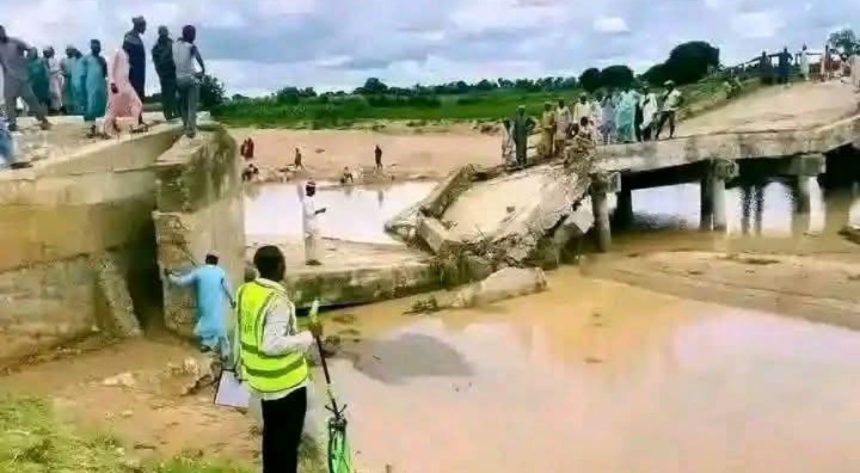
In Western Rogo, Kano State, life once moved in rhythm with the Gwangwan Bridge. Farmers crossed it daily, traders depended on it for market access, and students used it as a pathway to school. That rhythm broke the day the bridge collapsed.
For 56-year-old farmer Abubakar Hafizu, the morning began like any other. He loaded his cart with maize and headed toward Sundu Market, a journey he had made countless times over the years. But when he reached the crossing, the structure he depended on was gone.
By then, it was too late. A large portion of his harvest had already been damaged by flooding around the collapsed bridge.
“I lost over four million naira worth of maize,” he said quietly. “Most of it was destroyed. I didn’t know the bridge had given way.”
His loss reflects a wider crisis affecting several communities along the Gwangwan corridor in Western Rogo Local Government Area. What was once a functioning transport route has now become a barrier separating people from their livelihoods.
Residents say the impact did not come all at once. Instead, it unfolded gradually, through disruptions that accumulated over time—markets shrinking, school attendance dropping, and healthcare access becoming uncertain.
A community advocate, Sani Shuaibu Rogo, described the situation as a steady breakdown of daily survival systems.
“Household incomes have dropped drastically,” he said. “Young people are idle. Women who depended on small trading activities have nothing to fall back on. The bridge connected everything.”
Beyond economic hardship, the social structure of the communities has also been affected. Events that once brought people together—religious gatherings, cultural ceremonies, and family visits—have reduced significantly due to mobility challenges.
Elderly residents are among the most affected. Without easy access to transport routes, many now remain confined to their communities, unable to reach healthcare facilities or visit relatives as they once did.
Health concerns have become more serious. Pregnant women and emergency patients can no longer access Rogo General Hospital through the usual route, forcing residents to rely on longer, more difficult alternatives or go without care entirely.
Local observers say this disruption has turned routine medical access into a major challenge, with some cases worsening before help can be reached.
Education has also suffered. Parents now face difficult decisions about whether it is safe for children to cross alternative routes to school. As a result, school attendance has declined, raising concerns about long-term learning loss in the affected communities.
“It undermines the entire education system in the area,” said resident Usman Abubakar. “If children cannot physically reach school, policies around education become meaningless.”
While the infrastructure collapse has created immediate hardship, residents say the deeper issue is long-standing neglect. According to them, the bridge had been in deteriorating condition for years, despite repeated warnings.
Community members allege that political leaders have made multiple promises to repair the bridge during election periods, but those commitments were never fulfilled.
“Every election season, they come here,” said Shuaibu Rogo. “They promise to fix the road and the bridge. After the elections, nothing happens.”
This cycle of unfulfilled promises, residents say, has led to growing distrust in public institutions and elected officials. Many now feel abandoned by both local and state authorities.
In response, community representatives have submitted multiple appeals to government offices, urging urgent reconstruction of the bridge. However, there has been no clear timeline for intervention.
Shuaibu Rogo emphasized that the issue goes beyond infrastructure failure.
“The Gwangwan Bridge is not just a structure,” he said. “It is the lifeline of these communities. Its collapse has created poverty, unemployment, and isolation.”
For farmers like Abubakar Hafizu, the consequences are deeply personal. Farming continues, but access to markets has become uncertain. The predictable routine that once shaped his livelihood has been replaced by disruption and loss.
Now, residents wait for reconstruction that has yet to be announced, uncertain when normal life will return—or if it will return at all.
Until then, the broken bridge remains a daily reminder of how quickly infrastructure failure can reshape entire communities.
