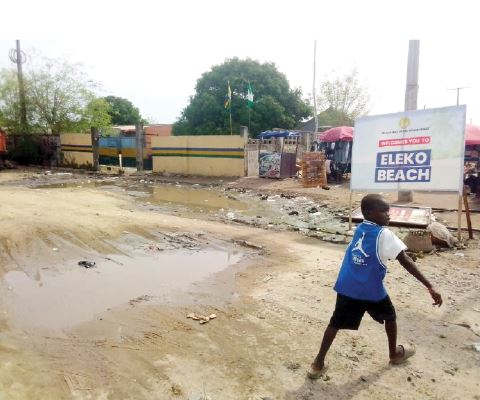
Leaders of the Ibeju-Lekki Ancestral Community Foundation have expressed concerns over an alleged blocked drainage channel along a section of the Lagos-Calabar Coastal Highway in Eleko, warning that the situation could trigger severe flooding and force residents from their ancestral communities during heavy rainfall.
The foundation, which represents more than 53 communities including Eleko, Museyo, Opo Ijebu and surrounding settlements, raised the concerns during a stakeholders’ meeting held at the Eleko Town Hall on Sunday.
Residents fear that the ongoing construction activities around the coastal highway may create environmental challenges capable of affecting homes, businesses, and livelihoods across affected communities.
Investigations during a visit to the area showed that several houses and shops situated along parts of the highway corridor now sit below road level, increasing fears that heavy rainfall could result in widespread flooding.
Community representatives also pointed to a drainage channel they claimed had been obstructed during construction activities.
Speaking on behalf of the affected communities, community leader Chief Adebayo Agbabiaka said residents were not opposed to development projects but remained worried about the environmental consequences.
“This drainage is about nine to 10 metres wide. Even a small downpour could become disastrous. We support development, but there is concern that homes in this area may not survive major rainfall if there is no proper water passage,” he said.
Agbabiaka further alleged that the blockage of the drainage route appeared intentional and could eventually force residents to abandon their communities.
According to him, frequent flooding could gradually displace residents from ancestral lands that have existed for decades.
He also restated the communities’ opposition to the proposed 150-metre setback along the Lagos-Calabar Coastal Highway corridor, insisting that many residents have nowhere else to relocate.
“We have appealed repeatedly that the 150-metre setback should be reconsidered. We have already given up large portions of land for national development projects and do not want our communities wiped out,” he said.
The community leader maintained that residents had made significant sacrifices over the years through land allocations for major national projects.
He listed projects including the Lekki Free Trade Zone, Dangote Refinery, seaport developments and other infrastructure initiatives as examples of contributions already made by local communities.
Youth coordinator of the affected communities, Ganiyu Adewale, also rejected suggestions of relocation or compensation.
He said residents unanimously agreed that communities should remain in their ancestral lands.
“The project came to meet the communities; the communities did not come to meet the project,” Adewale said.
According to him, local communities have continuously supported development initiatives despite the environmental and social impact on residents.
He explained that people are not against development but want policies that protect indigenous communities from displacement.
The concerns follow earlier reports of anxiety among residents over an alleged plan to enforce a 150-metre setback on both sides of the Lagos-Calabar Coastal Highway corridor.
However, a source within the Federal Ministry of Works reportedly explained that markings along the corridor were carried out by the Office of the Surveyor General of the Federation and did not automatically indicate demolition plans.
The source reportedly stated that affected structures were marked primarily to notify residents that certain areas fall within Federal Government land boundaries.
The Lagos-Calabar Coastal Highway remains one of the Federal Government’s largest infrastructure projects. The proposed 700-kilometre road network is expected to connect Lagos to Calabar through multiple coastal states.
Despite its projected economic impact, concerns surrounding displacement, land acquisition and environmental implications continue to generate debate among affected communities and stakeholders.