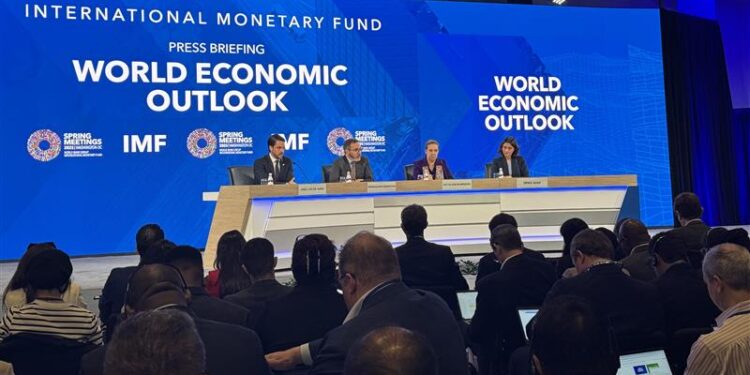
The International Monetary Fund has revised Nigeria’s economic growth forecast for 2026 downward to 4.1 percent, citing rising global uncertainties and domestic cost pressures impacting key sectors.
The latest projection represents a 0.3 percentage point drop from the 4.4 percent estimate released earlier in January 2026, reflecting a more cautious outlook for Africa’s largest economy.
Speaking during a briefing for the IMF’s April 2026 Global Financial Stability Report, Deniz Igan explained that the downgrade mirrors broader economic headwinds affecting Sub-Saharan Africa.
She noted that while the region recorded relatively strong growth in 2025, new global shocks—particularly ongoing geopolitical tensions—have weakened momentum.
According to the IMF, rising fuel, fertiliser, and shipping costs are expected to weigh heavily on Nigeria’s non-oil sectors, even as higher crude oil prices provide limited support to overall growth.
“Turning to Nigeria, we have revised growth down by 0.3 percentage points to 4.1 percent in 2026,” Igan said, highlighting the dual pressures shaping the country’s outlook.
The Fund also pointed to declining foreign aid across the region, with bilateral support falling between 16 and 28 percent in 2025—a trend expected to persist and further strain developing economies.
Nigeria’s macroeconomic environment remains challenging, with inflation recorded at about 15.06 percent year-on-year as of February 2026. Meanwhile, interest rates remain elevated, reflecting ongoing efforts by the Central Bank of Nigeria to stabilise prices and manage inflation expectations.
The IMF advised policymakers to maintain tight monetary conditions while closely monitoring exchange rates and inflation trends to sustain economic stability.
Globally, growth is also slowing. The IMF projects world output to decline from 3.4 percent in 2025 to 3.1 percent in 2026, before a modest recovery to 3.2 percent in 2027.
Advanced economies are expected to see slower expansion, with countries like the United States projected to grow at 2.3 percent in 2026, while the United Kingdom is forecast to expand by just 0.8 percent.
In Europe, Germany is expected to recover gradually, while India stands out among major economies with a strong growth projection of 6.5 percent.
Across Sub-Saharan Africa, growth is projected to ease slightly from 4.5 percent in 2025 to 4.3 percent in 2026, reflecting both external shocks and persistent structural challenges.
The IMF linked much of the current uncertainty to rising tensions in the Middle East, particularly around the Strait of Hormuz, a critical global oil transit route. Disruptions in the region have increased energy prices, shipping costs, and insurance premiums, placing additional strain on import-dependent economies like Nigeria.
These pressures have worsened trade conditions, contributed to inflation, and slowed economic expansion—factors now reflected in the IMF’s revised outlook.
Despite the downgrade, the Fund projects a modest recovery for Nigeria in 2027, suggesting that current challenges may ease if global conditions stabilise and domestic reforms gain traction.