


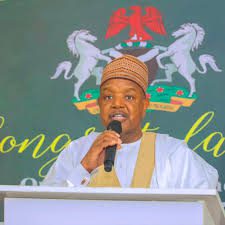
The Minister of Budget and Economic Planning, Abubakar Bagudu, says achieving Nigeria’s $1 trillion economy target within the next five years will depend on inclusive, innovative, and resilient national planning.
Bagudu disclosed this in Abuja on Tuesday at the maiden annual lecture of the Nathaniel Atebije Foundation for Planning Advocacy (NAFPA), themed “The Renewed Hope Agenda: The Physical Planning Perspective.”
Target Requires Broad-Based Strategy
The minister described the target as both a challenge and a responsibility, stressing that national planning must extend beyond economic projections to include physical, environmental, cultural, and social dimensions.
“Under the 2030 National Development Plan, President Bola Tinubu has challenged us to see how we can generate a one trillion dollars economy from the current 300 billion dollars in the next five years.
“Achieving it depends on three elements— inclusiveness, resilience, innovativeness. It includes everyone. Everyone has a role to play,” he said.
Inclusiveness Central to Development
Bagudu emphasised that inclusivity remains at the core of Nigeria’s development strategy, warning that poor planning and weak execution have historically contributed to conflicts across the country.
He linked the approach to the administration’s Renewed Hope Agenda, which focuses on growth, inclusion, and innovation.
“We are not where we want to be. But instead of dwelling on the past, we must make the right choices to move forward—choices that will grow the economy and include all Nigerians,” he said.
Experts Call for Integrated Planning
Also speaking, Vice-Chancellor of Bells University, Ota, Professor Jeremiah Ojediran, said development in Nigeria has remained fragmented due to weak planning integration.
“You cannot build roads without housing, or provide electricity without jobs. Everything must be interconnected,” he said.
He called for a shift from reactive to proactive planning, noting that infrastructure responses in Nigeria often occur only after crises such as flooding or congestion.
“It is after flood that we start talking about drainage. After congestion, we begin to act. Planning must be central, not an afterthought,” he added.
Need for Policy Alignment
Chairman of the occasion, David Garba, highlighted the disconnect between physical planning and economic planning as a major challenge.
“When we don’t have that connection, what you have is disjointed physical development within our urban centres,” he said.
Similarly, Chairman of the Board of Trustees of the foundation, Olutoyin Ayinde, stressed that planning should prioritise people and community wellbeing, not just infrastructure.
“Our concern should not be merely about bricks and mortar, but about people, who are the heartbeat of every human settlement,” he said.
Call for Collective Action
Founder of NAFPA, Nathaniel Atebije, said Nigeria stands at a critical point in its urban development journey and must embrace planning as a tool for order and sustainability.
“We can either continue on the path of disorder and crisis, or embrace planning as a tool for national development,” he said.
He called on government, professionals, and citizens to collaborate in restoring order, sustainability, and dignity in the built environment.
