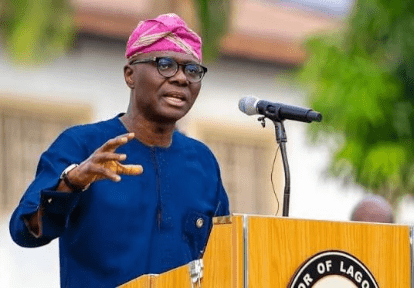
Lagos State Governor, Babajide Sanwo-Olu, has commended the European Investment Bank (EIB) for its support of the Omi Eko Project, describing the initiative as a transformative investment that will improve urban mobility, reduce travel time, and enhance the quality of life for Lagos residents.
Sanwo-Olu made the remarks during a courtesy visit by an EIB delegation led by the bank’s Vice President, Ambroise Fayolle, at Lagos House, Marina, over the weekend.
The governor said the Omi Eko Project aligns with his administration’s THEMES+ agenda, particularly the Transportation and Traffic Management pillar, which seeks to develop an integrated transportation network connecting road, rail, and water transport systems.
According to him, Lagos possesses vast water resources that can be harnessed to provide alternative transportation options and ease pressure on existing road infrastructure.
“The Omi Eko Project forms a critical part of Lagos State’s strategy to develop an integrated, intermodal transportation system that effectively combines road, rail, and water transport,” Sanwo-Olu said.
He explained that the project, whose name translates to “Water of Lagos,” will deliver modern and climate-resilient water transportation infrastructure, including upgraded ferry terminals, safer navigation channels, and improved commuter services.
The governor noted that the initiative is expected to significantly reduce commuting time for residents, with journeys that currently take up to two hours projected to be shortened to between 40 and 45 minutes.
Sanwo-Olu expressed appreciation to the EIB, the African Development Bank (AfDB), and other development partners for supporting Lagos State’s efforts to build a sustainable and efficient transportation system.
He added that expanding water transportation would provide commuters with more travel options while reducing congestion on roads and rail networks.
The governor also welcomed the EIB’s growing investment in Nigeria’s small and medium-scale enterprises (SMEs), describing the sector as a critical driver of economic growth and job creation.
According to him, Lagos remains committed to converting investment commitments secured during the recently concluded Lagos Investment Summit into tangible economic outcomes that benefit residents and businesses.
Earlier, EIB Vice President Ambroise Fayolle disclosed that Nigeria emerged as the bank’s largest country of operations in Africa in 2025, with total lending reaching €550 million.
He said the development reflected the strengthening partnership between Nigeria, the European Union, and the European Investment Bank.
Fayolle revealed that the EIB recently signed a €200 million financing facility with the Development Bank of Nigeria to support digital and green investments by micro, small, and medium-sized enterprises.
He also announced a separate financing agreement with Wema Bank aimed at improving access to finance for underserved businesses while encouraging environmentally sustainable practices.
Speaking on the Omi Eko Project, Fayolle described it as one of the European Union’s flagship infrastructure initiatives in Lagos.
He explained that the project is being jointly financed by the EIB, the European Union, and the French Development Agency, and will support the construction of modern ferry terminals and the deployment of electric boats across Lagos waterways.
“The initiative is designed to reduce congestion, improve environmental sustainability, and provide Lagos residents with a more efficient means of commuting,” Fayolle said.
The EIB delegation is expected to inspect several projects in Lagos, including investments supported through partnerships with the Bank of Industry, as part of ongoing efforts to strengthen collaboration and explore new opportunities for sustainable development in Nigeria.