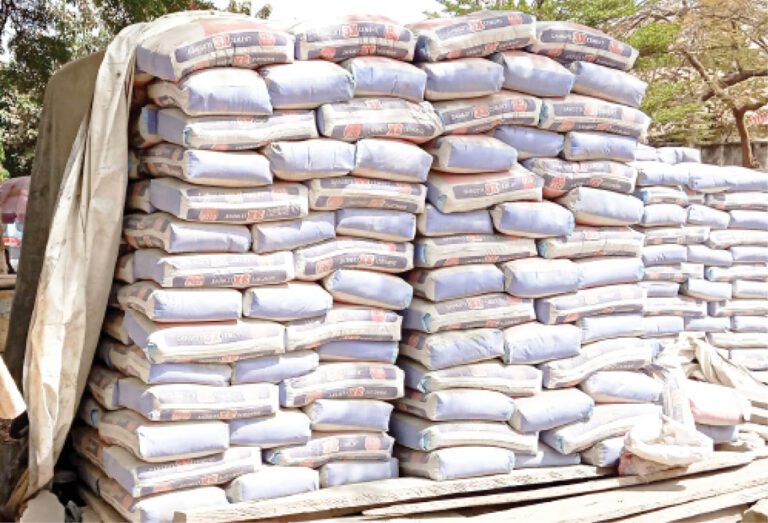
Stakeholders in Nigeria’s construction and housing sector have raised concerns over the rising cost of cement, warning that the current price of about ₦12,000 per 50kg bag could undermine efforts to achieve affordable housing across the country.
They argue that continued price increases in cement and other key building materials are making housing development increasingly expensive for both developers and individual homebuilders.
A market survey in parts of the Federal Capital Territory (FCT) shows that cement prices currently range between ₦11,800 and ₦12,000 per bag, depending on brand and location.
The development comes shortly after the Federal Government included cement among items restricted under its updated import prohibition list, alongside soaps, fertilisers, and several other goods under the 2026 fiscal policy framework.
The policy, which took effect from April 1, 2026, is part of the ECOWAS Common External Tariff arrangement aimed at regulating trade and boosting local production.
However, industry players say the policy environment has not translated into price stability in the domestic market.
Real estate expert Jide Fasuyi described the rising cost of cement as a major threat to housing delivery in Nigeria, especially at a time when government and private developers are trying to bridge the country’s housing deficit.
He questioned the justification for repeated price hikes despite the availability of raw materials used in cement production within Nigeria.
“It is disheartening to see how much Nigerians now pay for essential building materials like cement,” Fasuyi said. “Prices are increasing almost daily, and there is no clear justification for it.”
He added that raw materials such as limestone, clay, silica sand, gypsum, and iron ore are abundantly available locally, making it difficult to justify persistent price increases.
According to him, rising cement prices will directly translate to higher housing costs.
“Clearly, this is a crisis for housing delivery. When cement prices go up, house prices automatically rise, making affordability impossible,” he said.
Civil engineer Chukwuebuka Vincent also expressed concern over the sharp increase in construction costs, noting that cement prices have more than doubled in the past three years.
He recalled that in 2023, cement sold between ₦5,500 and ₦6,000 per bag, compared to the current average of about ₦12,000.
“As a civil engineer supervising projects, I have seen several sites abandoned due to rising costs,” he said. “Clients are unable to continue funding construction because of inflation in building materials.”
Vincent noted that Nigeria remains one of the largest cement producers in West Africa, with major manufacturers such as Dangote Cement, Lafarge, and Ibeto Cement contributing significantly to output.
He warned that sustained price increases would continue to push housing out of reach for many Nigerians.
“Affordable housing will remain difficult to achieve as long as cement prices stay this high,” he added.
Meanwhile, the Executive Director of the Housing Development Advocacy Network (HDAN), Barrister Festus Adebayo, said rising fuel prices are further worsening Nigeria’s housing crisis.
He explained that increased transportation and production costs are driving up prices of essential building materials.
“Cement, iron rods, tiles, and fittings have all become more expensive due to higher logistics costs linked to fuel prices,” he said.
Adebayo added that contractors are now passing increased operational costs to end users, making housing less affordable for middle-income earners.
He noted that labour costs have also risen as workers demand higher wages to cope with transportation expenses.
“As a result, many housing units that were once affordable are now beyond the reach of average Nigerians,” he said.
He warned that without urgent intervention, the housing deficit in Nigeria will continue to widen as affordability declines.