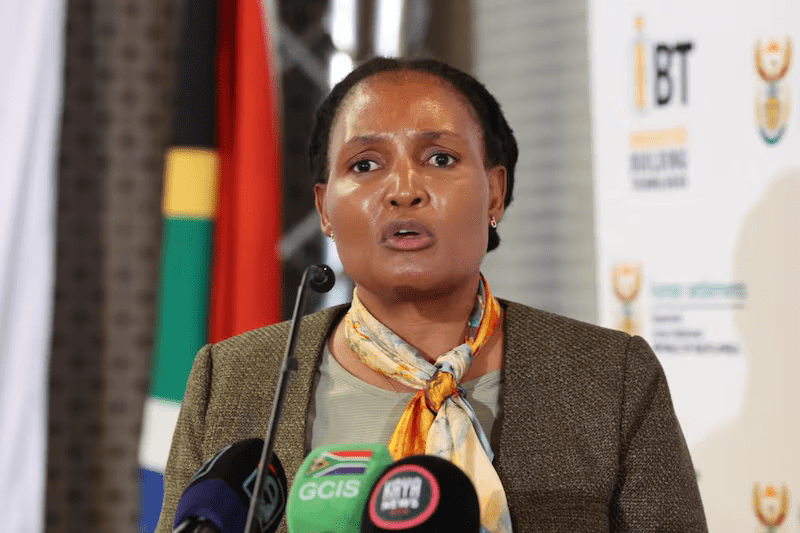
South Africa’s Minister of Human Settlements, Thembisile Simelane, has warned that significant budget cuts could undermine the government’s ability to meet housing delivery targets and address the country’s growing housing crisis.
Presenting Budget Vote 33 before Parliament, Simelane revealed that the department’s baseline allocation would be reduced by R20.6 billion over the Medium-Term Expenditure Framework, including a R19.7 billion reduction to the Urban Settlements Development Grant.
“The reality is that we are operating under severe fiscal constraints,” Simelane told lawmakers.
Housing Backlog Remains a Major Challenge
Despite government efforts, South Africa continues to face a substantial housing shortage. According to the minister, the national housing backlog currently stands at approximately 2.6 million units, while 11.7 percent of households still live in informal settlements.
For the 2026 financial year, the department plans to deliver:
- 39,058 housing units
- 25,186 serviced sites
- 21,918 title deeds
- 2,878 social housing units
- 744 houses for military veterans
- 6,950 mud-house replacements
- 11,215 solar energy installations
However, Simelane acknowledged that housing delivery fell below expectations in the previous financial year.
The department completed 23,027 housing units against a target of 37,779 units.
“This situation cannot continue,” she said, pledging stricter action against underperforming contractors and officials responsible for procurement delays.
Progress Recorded Despite Funding Constraints
The minister disclosed that government interventions have helped revive several stalled housing projects nationwide.
Out of 212 blocked housing developments identified across the country, 85 have been unblocked, resulting in the delivery of 1,136 housing units in Gauteng, KwaZulu-Natal, Mpumalanga, Limpopo, Free State and North West provinces.
She also noted that the Housing Development Agency exceeded expectations by acquiring 2,447 hectares of strategically located land, more than double its target of 1,000 hectares.
Additionally, provinces delivered 24,251 serviced sites against a target of 13,995.
Opposition Parties Reject Budget
Several opposition parties rejected the housing budget, arguing that it fails to adequately address South Africa’s housing challenges.
Democratic Alliance lawmaker Conrad Poole said the country’s housing crisis is now largely an implementation problem rather than a policy issue.
“Nonperformance, corruption, stalled projects and weak oversight have become legacy problems within the sector,” he said.
Meanwhile, MK Party lawmaker Thulani Gamede criticised the spending cuts, arguing that government was retreating from its responsibility to provide housing for vulnerable citizens.
“Housing is not merely a commodity. It is a fundamental right,” he said.
Members of the Economic Freedom Fighters also opposed the budget, saying it does little to reverse apartheid-era spatial planning patterns that continue to push low-income communities to the outskirts of cities.
Calls for Inclusive Urban Development
Lawmakers and housing advocates stressed that housing delivery should go beyond constructing homes and focus on creating sustainable communities with access to transportation, healthcare, education and economic opportunities.
According to Rise Mzansi lawmaker Makashule Gana, human settlements should not consist of houses located far from jobs and essential services.
As South Africa grapples with fiscal pressures and rising housing demand, the debate highlights the challenge of balancing budget constraints with the constitutional obligation to provide adequate housing for millions of citizens.