


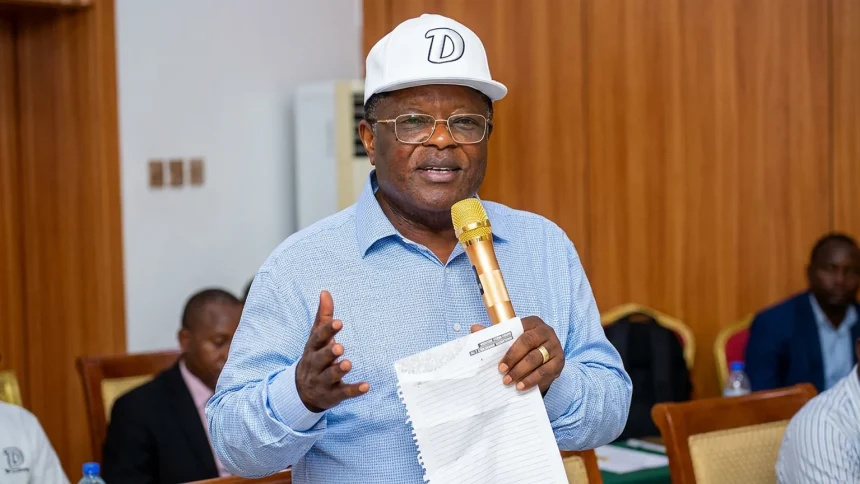
The Minister of Works, David Umahi, has defended President Bola Tinubu’s borrowing strategy, saying the administration is taking loans to fund critical road infrastructure seen as essential for security, commerce, and national development.
Speaking in Abuja during a visit by the Inspector General of Police, Olatunji Disu, to the Ministry of Works, Umahi said road infrastructure remains central to Nigeria’s economic progress.
“When people say, ‘Why is he borrowing?’ the President is borrowing so that our roads can be good. Without roads, security agencies cannot function effectively, commerce cannot thrive, and even education will be affected,” Umahi said.
Nigeria’s Debt Stock Continues to Rise
The minister’s remarks come as Nigeria’s external borrowing profile continues to expand.
According to data from the Debt Management Office (DMO), Nigeria’s total external debt rose to $51.86 billion in December 2025, representing a 13.27 per cent increase from $45.78 billion recorded in December 2024.
Between September and December 2025 alone, external debt rose from $48.46 billion to $51.86 billion, indicating continued reliance on foreign borrowing to finance public expenditure and development projects.
Economic analysts estimate that since May 2023, the Tinubu administration has accumulated between N57 trillion and N65.9 trillion in new public debt, driven by infrastructure funding needs, budget deficits, and ongoing economic reforms.
Most Ongoing Projects Inherited from Past Governments
Umahi explained that more than 80 per cent of ongoing federal projects, valued at about N34 trillion, were inherited from previous administrations, some dating back to 2000, 2015, and 2017.
He said the government chose to continue these projects because of their strategic importance to national development.
Reinforced Concrete Roads to Last Decades
The Minister also highlighted the adoption of reinforced concrete pavement technology for major road projects, stating that the approach is designed to ensure durability.
According to him, completed roads are expected to last between 50 and 100 years with minimal maintenance.
He listed major legacy projects under the administration, including:
- Lagos–Calabar Coastal Highway
- Sokoto–Badagry Highway
- Calabar–Ebonyi–Benue–Kogi–Nasarawa–Abuja corridor
- Akwanga–Jos–Bauchi–Gombe–Biu–Maiduguri route
Progress on Key Infrastructure Projects
Umahi disclosed that Section One of the Lagos–Calabar Coastal Highway (47.47km) has been completed and is already attracting investor interest in toll-based financing models.
He also said the Federal Government has approved solar lighting for the 375km Abuja–Kaduna–Zaria–Kano road, with the first 118km completed at a cost of N252 billion. The second phase, covering 164km, is expected to be completed by November.
Nigeria’s External Debt Profile Expands
Data from the DMO shows Nigeria’s external debt is heavily concentrated among a few major international creditors, including:
- Eurobond investors
- International Development Association (IDA)
- African Development Bank (AfDB)
- International Bank for Reconstruction and Development (IBRD)
These institutions account for a significant share of Nigeria’s foreign borrowing portfolio.