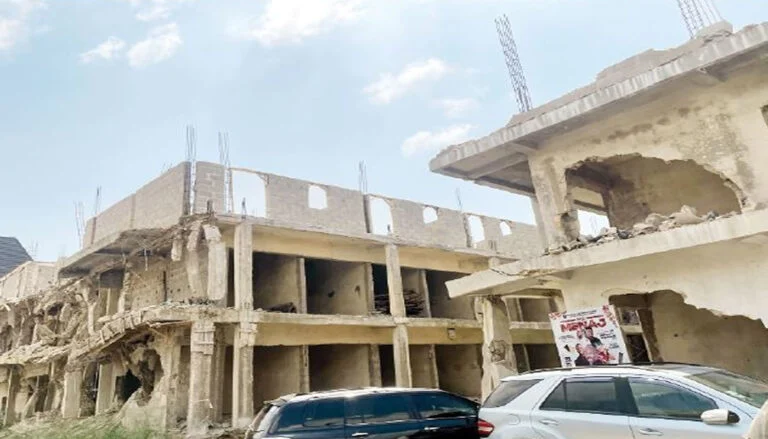
For thousands of Lagos residents, urban renewal has ceased to sound like development and has instead become synonymous with sudden loss.
In neighbourhoods such as Oworonshoki, the arrival of bulldozers did not mark progress but the erasure of homes, histories and livelihoods built over decades.
Families recount how structures they laboured years to erect were partially or completely demolished, often without what they consider adequate compensation or sufficient engagement. In Coker Estate, Oworonshoki, landlord Saka Abimbola said his property was damaged during the exercise, leaving him financially exposed and emotionally drained.
“Not a single person in this estate received compensation,” he said. “We begged the authorities for almost a year. They promised, but still came back to demolish. At this point, it’s not about documents. It feels like they simply want the land.”
Other residents echo the belief that the demolitions are less about environmental concerns and more about the rising commercial value of waterfront locations. Ganiyu, another affected resident, argued that prime coastal areas are increasingly attracting investors, making long-standing communities vulnerable.
Government officials, however, reject accusations of land grabbing. The Lagos State Physical Planning Permit Authority maintains that compensation was paid and that due process was followed. According to its Permanent Secretary, Sotire, dissatisfaction is inevitable regardless of the sums offered.
“No matter what government does, some people will still not be happy,” he said, insisting that notices were issued and consultations held before the exercise.
Yet professionals within the property sector question the fairness of the compensation framework. Property valuer Adeyemi Bamikunle described reported payments ranging from a few hundred thousand naira to about ₦1m as grossly inadequate within Lagos’ inflated real estate market.
“Those figures do not reflect economic reality,” he said. “They don’t come close to replacing what was lost. It barely scratches the surface of construction costs, let alone relocation.”
Urban planning experts argue that renewal should not translate into sudden displacement. Dr Moses Ogunleye, a town planner and former president of the Association of Town Planning Consultants of Nigeria, stressed that regeneration must be gradual, participatory and humane.
“Urban renewal is lawful, but it must be people-centred,” he said. “Residents should be informed years ahead, alternatives provided, and relocation planned in phases. Development should not feel like an ambush.”
Beyond economics, real estate stakeholders warn of deeper psychological damage. The President of the Real Estate Developers Association of Nigeria, Oba Akintoye Adeoye, described the demolitions as an uprooting of identity.
“When ancestral homes are erased, burial grounds disturbed, and familiar landmarks wiped out, it creates lasting trauma,” he said. “Development should not come at the cost of human dignity.”
Housing policy analysts also advocate collaboration rather than confrontation. Jennifer Stephen, founder of the ACR Housing Collective, said governments must abandon top-down regeneration models.
“Urbanisation should be co-created,” she said. “Instead of demolishing, authorities can work with property owners to upgrade structures and share responsibility.”
Legal experts have raised concerns about constitutional safeguards. Lagos-based lawyer Festus Ogun noted that while land is vested in governors under the Land Use Act, global best practices discourage forced evictions without due process.
Another lawyer, Bolaji Oluwatosin, who represented protesters arrested during the demolitions, argued that the exercise exposed gaps between state power and citizens’ rights.
“Court injunctions were allegedly in place, yet demolitions reportedly occurred at night,” he said. “Whether served or not, the rule of law demands restraint and transparency.”
The Lagos State Government insists the renewal drive is not anti-poor. Commissioner for Information and Strategy, Gbenga Omotoso, said the focus is environmental safety and sustainability, not displacement.
“Urbanisation is not a war against the poor,” he said. “We are removing structures that pose environmental risks. We are also building housing estates and allocating a percentage to low-income earners.”
Still, critics argue that policy assurances offer little comfort to families already rendered homeless. As Lagos continues its race toward becoming a megacity, the tension between development and displacement remains unresolved.
This report is inspired by and based on investigative reporting by Gbenga Oloniniran published by The PUNCH Newspapers, rewritten with additional analysis and a new narrative structure by Housing tv Africa