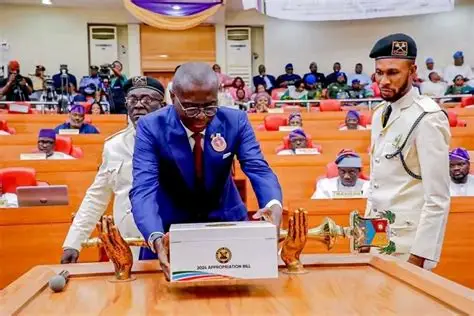
The Lagos State House of Assembly has formally approved a ₦4.44 trillion budget for the 2026 fiscal year, marking one of the largest allocations in the state’s history.
The approval was secured during Thursday’s plenary session presided over by the Speaker, Mudashiru Obasa, who directed the Clerk of the House, Olalekan Onafeko, to transmit a clean copy of the appropriation bill to Governor Babajide Sanwo-Olu for assent.
The 2026 budget, tagged the “Budget of Shared Prosperity”, is designed to promote inclusive growth and enhance the welfare of residents across the state. Governor Sanwo-Olu had initially presented a proposed ₦4.237 trillion budget on November 25, 2025, emphasizing the administration’s commitment to equitable development and public service efficiency.
Chairman of the House Committee on Economic Planning and Budget, Olumoh Sa’ad, highlighted that the approved budget allocates ₦2.11 trillion for recurrent expenditure and ₦2.34 trillion for capital projects, reflecting a balanced focus on operational sustainability and infrastructural development.
The recurrent expenditure component will cover salaries, allowances, and other statutory obligations, while the capital expenditure allocation targets strategic investments across sectors such as transport, health, education, and urban development.
Governor Sanwo-Olu emphasized that the 2026 spending plan aligns with the state’s T.H.E.M.E.S+ Agenda, focusing on a human-centred approach, modern infrastructure, a thriving economy, and effective governance.
The administration aims to prioritize social welfare, address poverty, and ensure equitable access to public services. Investments in roads, water supply, power distribution, and urban renewal are designed to alleviate persistent urban challenges, while policies to support businesses and create jobs are intended to strengthen the state’s economic base.
Transparency, accountability, and technology-driven service delivery remain central to the government’s strategy.
For Lagos residents, the approved budget signals opportunities for tangible improvements in socio-economic conditions.
Funding in critical sectors such as healthcare, education, and transportation is expected to enhance public service delivery, while large-scale infrastructure projects aim to reduce traffic congestion, expand housing, and improve utilities.
By linking recurrent and capital spending to measurable outcomes, the government intends to maximize the impact of public resources on the welfare of citizens.
With the passage of the appropriation bill, all legal formalities now require Governor Sanwo-Olu’s assent before the funds can be disbursed.
Once signed into law, implementation will commence with priority projects identified to deliver significant socio-economic benefits by the end of 2026.
Analysts note that the 2026 Lagos budget reinforces the state’s position as an economic hub in Nigeria, demonstrating fiscal discipline while addressing the pressing needs of its residents.
The approval process also underscores the House of Assembly’s oversight role in ensuring public funds are allocated transparently and strategically.