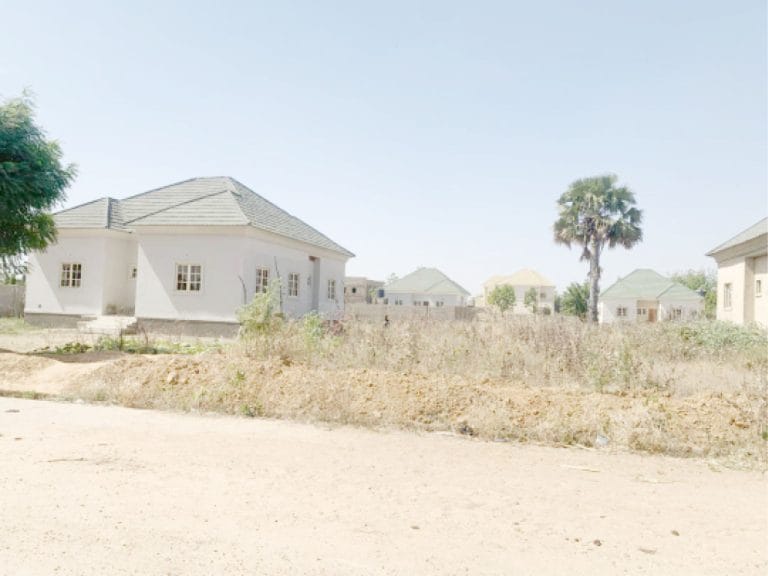
More than a decade after its commissioning, the Kwankwasiyya Mega City in Kano remains largely unoccupied, raising fresh concerns over housing affordability and urban planning in Nigeria.
The mega housing project, initiated in 2012 by the administration of Rabiu Musa Kwankwaso, was designed to decongest Kano metropolis and transform the state into a modern urban centre.
The development, which includes Kwankwasiyya, Amana, and Bandirawo cities, delivered about 1,500 housing units, including over 500 luxury apartments in Kwankwasiyya alone by 2015.
Despite an investment exceeding N35 billion, the estate has recorded low occupancy rates, with only a fraction of homeowners residing in the city years after completion.
Infrastructure in Place, Residents Missing
The city was designed as a fully integrated urban centre, with facilities such as hospitals, schools, commercial plots, mosques, parks, and a conference centre.
However, findings indicate that physical occupation has remained limited due to factors including security concerns, distance from the city centre, and inadequate access to basic services such as water.
Governor Abba Kabir Yusuf, who assumed office in 2023, expressed concern over the low occupancy rate during a visit to the estate.
In a bid to boost confidence, the administration began holding state executive council meetings at the Government Lodge within the estate in 2025, signalling improved security and readiness for habitation.
Government Interventions Yield Moderate Gains
To address infrastructure challenges, the state government connected the estate to the Tiga Hydropower Plant to ensure stable electricity supply.
A dedicated Ministry of Housing Development was also established to oversee housing projects and improve management efficiency.
Permanent Secretary of the ministry, Tijjani Muhammad Sharif, said occupancy has improved to about 60 per cent following recent interventions, including a directive compelling property owners to complete and occupy their homes or risk revocation.
However, the government’s recent acquisition of 324 housing units previously allocated to the state pension union indicates that a significant number of houses remain either unsold or unoccupied.
Affordability Concerns Persist
Civil servants and residents have attributed the low occupancy largely to affordability challenges, arguing that the houses are priced beyond the reach of average income earners.
Some respondents alleged that many of the properties were initially allocated to political elites and senior officials, limiting access for ordinary citizens.
A civil servant, Abdullahi Yusuf, said the cost of housing units—estimated at over N20 million—makes ownership unrealistic for most workers.
Another respondent noted that limited access to mortgage financing further constrains potential buyers, particularly those nearing retirement.
Policy Gaps and Allocation Concerns
Stakeholders have also raised concerns over allocation practices, alleging that some beneficiaries resold properties for profit instead of occupying them.
They argued that earlier government housing schemes, such as Kundila Housing Estate, were more inclusive and enabled civil servants to own homes.
Officials, however, maintained that houses were offered to civil servants at discounted rates, but many were unable to meet the financial requirements.
The standard purchase model requires an initial 10 per cent deposit, with the balance spread over 10 years. However, for Kwankwasiyya, buyers were required to make outright payments, further limiting accessibility.
Broader Housing Implications
The situation reflects a broader contradiction in Nigeria’s housing sector, where high-end developments coexist with a significant housing deficit.
Experts say aligning housing design with income realities, improving mortgage access, and ensuring transparent allocation processes are critical to achieving sustainable urban housing solutions.