


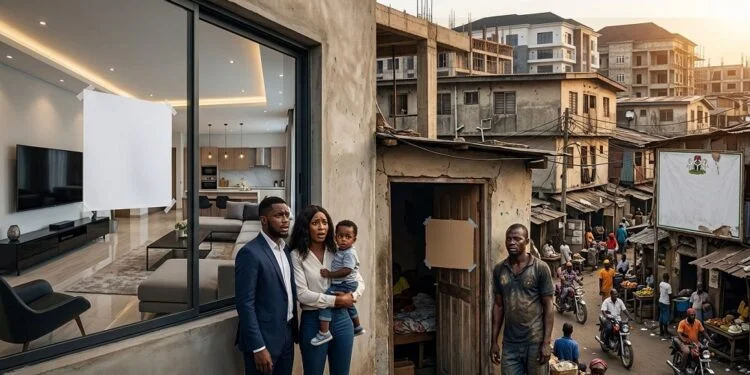
Nigeria’s housing affordability crisis is deepening as rising rents continue to outpace the incomes of millions of households, leaving many residents struggling to secure decent accommodation.
The growing pressure is being driven by a combination of low household incomes, rising construction costs, inflation and limited access to affordable housing finance.
For many Nigerians, housing now consumes a disproportionate share of household earnings, leaving less money available for food, transportation, education and other essential expenses.
Rising Rents Put Pressure on Households
Rental costs have increased sharply across major Nigerian cities as landlords and developers face higher costs for building materials, labour, energy, transportation and land.
The situation is particularly difficult for low- and middle-income earners who have seen their incomes grow more slowly than housing costs.
Recent reporting on Abuja’s rental market, for example, found that rents in several districts have increased by between 40 and 120 per cent over the past two years. In Lokogoma, a two-bedroom apartment that previously rented for about ₦1.2 million was reported to cost as much as ₦2.5 million annually.
Additional expenses such as agency fees, legal charges, caution deposits and service charges can push the actual cost of securing accommodation even higher.
Housing Costs Outpace Income
The problem is not simply that rents are increasing. It is that household incomes are failing to keep pace.
When a large proportion of monthly income is committed to rent, households have limited capacity to save, invest or respond to unexpected expenses.
The situation can also force residents to move farther away from employment centres in search of cheaper accommodation. But cheaper rent often comes with higher transportation costs and longer commuting times.
This creates a cycle in which households may save on rent while spending more on transportation.
Construction Costs Add to the Problem
Developers and landlords have attributed much of the increase in rents to rising construction costs.
Cement, reinforcement, paints, electrical materials, diesel and transportation have all become more expensive, increasing the amount required to build and maintain residential properties.
In Abuja, for example, cement prices have risen substantially from levels recorded two years ago, adding pressure to development costs.
Recent scrutiny of Nigeria’s cement market by the Federal Competition and Consumer Protection Commission (FCCPC) has also raised questions about why cement prices remain high despite Nigeria’s significant limestone resources and installed production capacity.
The Affordability Problem Goes Beyond Rent
Nigeria’s housing challenge cannot be solved simply by asking landlords to reduce rents.
The underlying problem includes the cost of land, expensive construction materials, inadequate infrastructure, limited housing supply and weak access to long-term mortgage financing.
These factors all feed into the final price paid by households.
Affordable housing therefore requires intervention across the entire housing value chain, from land acquisition and infrastructure to construction finance and mortgages.
More Housing Is Not Enough
Increasing the number of housing units is important, but supply alone does not automatically create affordability.
If newly constructed homes are priced beyond the reach of ordinary workers, they may add to the country’s housing stock without significantly improving access for the people most affected by the crisis.
This is why housing policy needs to distinguish between housing delivery and affordable housing delivery.
Government programmes, private developers and housing-finance institutions will need to pay greater attention to the income levels of the households they are trying to serve.
A Growing Urban Challenge
The affordability crisis is also changing the way Nigerians live and work.
Residents are increasingly moving toward satellite communities where accommodation may initially be cheaper. However, the resulting increase in commuting distances can create additional financial and social pressure.
Recent reporting on Abuja found that residents are increasingly moving toward areas such as Gwagwalada, Kubwa and Mararaba as rents in central and established districts rise.
The trend highlights the need for housing development to be coordinated with transportation, employment centres and infrastructure.
What Needs to Change?
Addressing Nigeria’s housing affordability crisis requires more than isolated housing projects.
Government can improve access to serviced land, reduce unnecessary development costs, strengthen housing finance and support large-scale affordable housing programmes.
At the same time, developers need access to cheaper long-term capital that can reduce the cost of delivering homes.
Housing-finance institutions also have a role to play in expanding mortgages to households that currently cannot afford conventional home loans.
Ultimately, the success of Nigeria’s housing policy should not only be measured by the number of houses constructed.
The more important question is whether ordinary Nigerian households can afford to live in them.
