
Businesses under the Dangote Group are spending ₦3.3 trillion ($2.2 billion) on road infrastructure in Nigeria to improve the movement of goods and reduce transportation costs across the country.
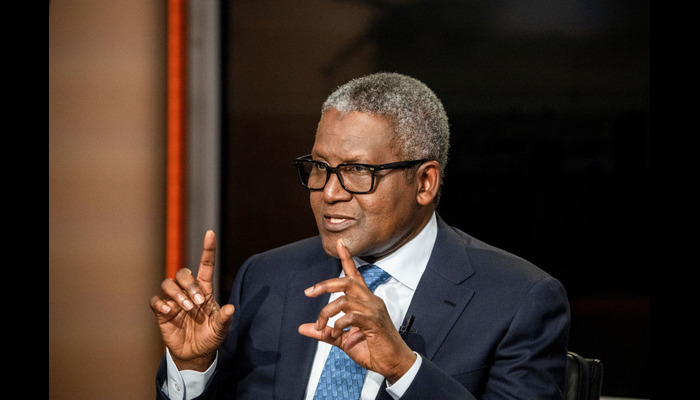
Aliko Dangote disclosed this during a summit in Accra, Ghana, where he met with President John Mahama, according to a Bloomberg report.
The investment is aimed at improving road networks used by the conglomerate to transport products from its manufacturing facilities to markets across Nigeria.
Dangote Group Operates 14,000 Trucks
Dangote disclosed that his businesses operate approximately 14,000 trucks in Nigeria, highlighting their dependence on the country’s road network for the distribution of goods and raw materials.
The group has interests in cement manufacturing, petroleum refining, sugar processing, food production, automobile manufacturing, shipping, power and real estate.
According to World Bank data cited in the report, more than 90 per cent of passenger and freight movements in Nigeria rely on road transportation, while approximately 80 per cent of the country’s roads are in poor condition.
The state of road infrastructure has increased transportation costs and created logistical challenges for manufacturers and distributors moving goods across the country.
Dangote Proposes 1,000km West African Road
Beyond Nigeria, Dangote has proposed the construction of a 1,000-kilometre road connecting Nigeria, Ghana and Côte d’Ivoire to improve regional transportation and boost cross-border trade.
He said he intended to engage President John Mahama and other regional leaders to ensure the proposed project receives priority attention.
Dangote identified inadequate transportation infrastructure as a major obstacle to trade and economic growth across West Africa.
He also argued that stronger regional manufacturing and trade could support the introduction of a common currency within the Economic Community of West African States (ECOWAS).
Dangote’s Previous Road Infrastructure Investments
The latest spending announcement follows the group’s involvement in several federal road construction projects under the Road Infrastructure Development and Refurbishment Investment Tax Credit Scheme.
In August 2024, the Federal Ministry of Works identified nine federal road projects being financed by the Dangote Group under the scheme.
Some of the projects include the 35-kilometre Apapa-Oworonshoki Expressway in Lagos, a 38-kilometre section of the Abuja-Kaduna-Kano Road and the 49.577-kilometre Dikwa-Gamboru-Ngala Road in Borno State.
Other projects include the 105-kilometre Obelle-Ilaro-Papalanto-Shagamu Road, the 65.5-kilometre Afikpo-Okigwe Road and the Nnamdi Azikiwe Road Western Bypass in Kaduna.
The group is also financing the 54.239-kilometre Lekki Deep Sea Port Road and 53.7 kilometres of side lanes serving the port in Lagos.
In June 2025, President Bola Tinubu commissioned a 37-kilometre section of the Lekki Deep Sea Port Access Road, connecting the Dangote Refinery and Fertiliser Plant to Eleko Junction.
Dangote Targets $70 Billion Investment Across Africa
The road infrastructure spending comes as Dangote continues to expand his business interests across Africa, with a target of increasing his planned investments on the continent to $70 billion by the end of the decade.
The group has announced more than $35 billion in infrastructure projects across Africa, including a proposed $16 billion refinery in Kenya with a planned processing capacity of 700,000 barrels of crude oil per day.
In Nigeria, the group also plans to invest $14.3 billion to expand its refinery near Lagos, increasing its capacity to 1.4 million barrels per day.
Meanwhile, Dangote Petroleum Refinery is undertaking an initial public offering that has attracted approximately ₦5.85 trillion ($4.3 billion) in applications, nearly three times the amount it sought to raise.
The investments reflect the group’s expansion across manufacturing, energy and infrastructure, with transportation remaining a major consideration for the movement of goods and the distribution of products across African markets.