


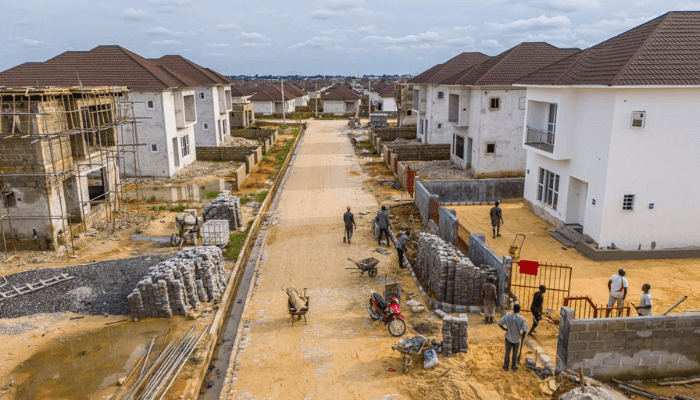
As Nigeria approaches the 2027 general elections, housing industry experts have called on political parties and presidential candidates to make more ambitious, measurable and realistic commitments to addressing the country’s growing housing deficit.
The experts argue that promises to deliver one million housing units annually are insufficient without clear implementation strategies, sustainable financing and policies that make homes accessible to ordinary Nigerians.
Nigeria’s housing deficit is estimated at approximately 28 million units, making it one of the largest housing challenges in Africa. Industry estimates indicate that the country needs to deliver about 700,000 housing units annually over the next decade to significantly address the shortage, while actual annual housing delivery remains slightly above 50,000 units.
The experts stressed that closing the housing gap requires a more substantial commitment from government, particularly as population growth, rapid urbanisation, rising construction costs and limited access to mortgage financing continue to widen the gap between housing demand and supply.
Their comments came during an Arise News programme examining the housing manifestos of leading political parties and their presidential candidates ahead of the 2027 general elections.
The discussion focused on the housing commitments of the All Progressives Congress (APC), Social Democratic Party (SDP) and Allied People’s Movement (APM), represented by Bola Tinubu, Adewale Adebayo and Seyi Makinde, respectively.
Ethiopia’s Housing Ambition Raises Questions for Nigeria
The discussion also highlighted Ethiopia’s ambitious plan to construct 1.5 million homes over five years, announced by Prime Minister Abiy Ahmed.
The initiative has renewed conversations about the scale of housing investment African governments can achieve through sustained political commitment and coordinated housing programmes.
Comfort Olugbami, founder and managing director of 1159 Realty, described Ethiopia’s target as ambitious but achievable, pointing to the country’s reported delivery of 1.2 million homes under an earlier housing programme.
She said Ethiopia’s progress demonstrates the need for Nigeria to reconsider its approach to housing delivery and set more ambitious national targets.
Tunde Balogun, founder and chief executive officer of Small Small, also questioned why Nigeria, despite having a larger population, continues to lag behind Ethiopia in addressing its housing requirements.
He argued that although Ethiopia still faces significant housing needs relative to its population, its progress demonstrates the importance of sustained government action.
Ayo Ibaru, chief investment officer at Panterra, however, cautioned that Ethiopia’s housing target should also be assessed against its actual population growth and housing requirements.
He estimated that Ethiopia would need to construct between 450,000 and 500,000 homes annually to adequately respond to its housing demand.
Housing Affordability Remains Nigeria’s Biggest Challenge
Beyond the number of houses constructed, experts stressed that affordability remains one of the most significant obstacles confronting Nigeria’s housing sector.
With the national minimum wage at ₦70,000 monthly, the conventional housing affordability benchmark of spending no more than 30 per cent of income on accommodation translates to approximately ₦21,000 monthly.
However, prevailing rental prices across major Nigerian cities are significantly higher than what many low-income households can comfortably afford.
Olugbami argued that affordable housing remains largely inaccessible to low-income earners because existing rental prices and mortgage financing arrangements do not adequately reflect household earnings.
She maintained that private developers cannot independently resolve the affordability challenge without meaningful government intervention, improved household incomes and more accessible housing finance.
The experts’ concerns highlight the need for housing policies that address both housing supply and the financial capacity of Nigerians to rent or purchase homes.
Experts Call for Stronger Housing Commitments Ahead of 2027 Elections
With political parties preparing their manifestos ahead of the next general elections, housing stakeholders believe candidates must move beyond broad promises and present practical strategies for addressing the country’s housing crisis.
They argue that commitments to deliver millions of homes must be supported by clearly defined funding arrangements, implementation timelines, land acquisition strategies and partnerships with private developers.
The housing sector also requires stronger mortgage financing systems, improved access to serviced land, reduced construction costs and policies that encourage institutional investment in affordable residential developments.
Nigeria’s housing deficit is not simply a construction challenge. It is also a financing, land administration, infrastructure and economic affordability problem.
Addressing these interconnected issues will require sustained collaboration between federal and state governments, financial institutions, developers, construction companies and other stakeholders.
As the 2027 elections approach, the experts believe housing should become a central issue in political campaigns, with Nigerians demanding commitments that translate into measurable improvements in housing delivery and affordability.
Ultimately, the success of any national housing programme will depend not only on how many homes government promises to build, but also on how many are completed, where they are located and whether ordinary Nigerians can afford to live in them.