


The House of Representatives has advanced President Bola Tinubu’s proposed N65.17 trillion revised 2026 budget for legislative consideration, following a request to reduce the country’s existing N68.32 trillion spending plan.
Rewritten news report
The House of Representatives has passed the proposed N65.17 trillion 2026 Appropriation Bill for second reading, advancing the Federal Government’s plan to revise the country’s existing budget.
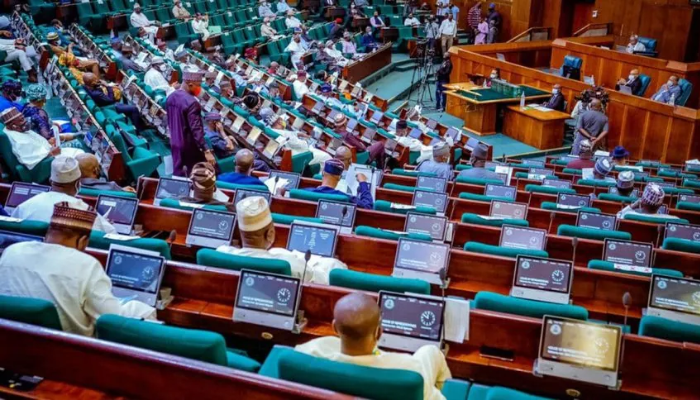
The bill was read for a second time during Wednesday’s plenary session, November 25, 2026, following President Bola Tinubu’s request for the repeal and re-enactment of the 2026 Appropriation Act.
The proposed N65,176,474,635,720 expenditure represents a reduction of approximately N3.15 trillion from the N68.32 trillion budget earlier approved by the National Assembly and signed into law in April 2026.
Under the revised spending framework, the proposed expenditure is divided into four major components: N4.43 trillion for statutory transfers, N21.19 trillion for debt servicing, N15.73 trillion for recurrent non-debt expenditure and N23.83 trillion for capital expenditure through the Development Fund.
Capital expenditure accounts for the largest share of the proposed budget, while debt servicing represents the second-largest allocation.
President Tinubu explained that the proposed adjustments were designed to align government spending with existing financial obligations and available resources.
The revision is also expected to accommodate certain expenditures incurred by the Nigerian National Petroleum Company Limited (NNPCL) on behalf of the Federation, address underprovided debt-service obligations, recognise issued capital warrants and provide refunds to Ministries, Departments and Agencies (MDAs).
The revised fiscal framework puts projected Federal Government revenue at N33.72 trillion, while aggregate capital expenditure is estimated at N26.23 trillion.
Despite the reduction in overall spending, the fiscal deficit remains unchanged at N31.46 trillion, representing 5.64 per cent of the country’s Gross Domestic Product.
The government’s planned new borrowing also remains at N29.22 trillion, comprising N18.43 trillion in domestic borrowing and N10.79 trillion in foreign borrowing.
Priority areas under the revised capital spending framework include the completion of critical road projects, support for agricultural production, reduction of production costs, improved farm yields, enhanced market access and interventions to address water vulnerability.
The bill will undergo further legislative scrutiny before the revised appropriation can take effect.
The proposed adjustment comes as the Federal Government seeks to improve budget implementation, meet outstanding financial obligations and ensure that available resources are directed towards priority projects before the end of the 2026 fiscal year.