


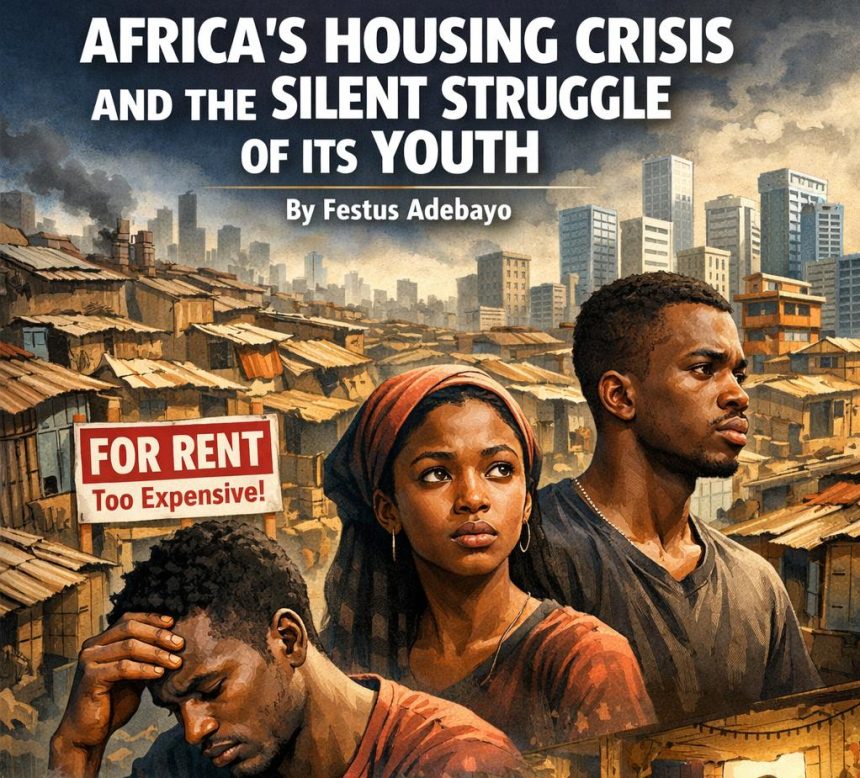
By Festus Adebayo
Across Africa today, one of the most pressing yet under-discussed challenges confronting young people is the growing housing crisis. While conversations around unemployment, education, and economic empowerment dominate policy spaces, access to decent and affordable housing has quietly become a defining factor shaping the future of Africa’s youth.
From Lagos to Nairobi and Accra, the story is the same—young people are increasingly priced out of the housing market. Even those with stable jobs find it nearly impossible to afford rent, let alone own homes. The widening gap between income levels and housing costs has created a situation where decent accommodation is now a luxury rather than a basic necessity.
This crisis is not just about shelter—it is about dignity, stability, and opportunity.
For many young Africans, the inability to access housing is delaying critical life decisions. Marriage is postponed, family plans are put on hold, and independence is deferred. A generation that should be building its future is instead stuck navigating survival.
More troubling is the rise in informal and substandard housing. With limited options, many youths are forced into overcrowded environments, unsafe buildings, and poorly serviced communities. These conditions come with significant health risks, security concerns, and a diminished quality of life.
The economic implications are equally severe. When young people spend 40 to 60 percent of their income on rent, their ability to save, invest, or start businesses is severely constrained. Housing, which should be a foundation for economic growth, is instead becoming a barrier to it.
There is also a growing psychological toll. Housing insecurity breeds stress, anxiety, and a sense of exclusion. Many young people feel locked out of a system that seems to favour only a privileged few. If left unaddressed, this could deepen inequality and fuel social unrest across the continent.
What Government Must Do
Addressing the housing crisis among youths requires deliberate, targeted, and sustained action by governments across Africa.
First, there is a need to prioritise affordable housing as a national development agenda. Governments must move beyond rhetoric and commit to large-scale housing delivery programmes that specifically target young people and low-income earners.
Second, access to land must be simplified and made more affordable. Land remains one of the biggest barriers to housing development. Transparent land administration systems, reduced costs of title registration, and digitisation of land records will significantly unlock opportunities for youth participation in housing.
Third, governments must create innovative housing finance systems tailored to young people. Traditional mortgage systems often exclude youths due to strict requirements. Flexible products such as rent-to-own schemes, micro-mortgages, and cooperative housing models should be encouraged.
Fourth, there is a need to support local building materials and alternative construction technologies to reduce the cost of housing. Industrialised building systems and local innovations can significantly bring down construction costs and make housing more accessible.
Fifth, governments should partner with the private sector and development institutions to scale up housing supply. Public-private partnerships remain one of the most effective ways to bridge the housing gap.
Finally, policies must deliberately integrate youths into housing value chains—not just as beneficiaries, but as active participants in construction, design, technology, and housing finance ecosystems.
The Role of Strategic Platforms
Solving Africa’s housing challenge requires collaboration, innovation, and sustained dialogue. This is where platforms like the Africa International Housing Show play a critical role.
As Africa’s largest housing and construction gathering, AIHS provides a unique opportunity for stakeholders to come together to develop practical, scalable solutions to housing challenges across the continent.
At the 20th anniversary edition—AIHS @20—there is a renewed focus on housing solutions for low-income and informal workers, a category that includes a large percentage of African youths.
Importantly, AIHS is also taking a bold step by introducing a Professional Youth Club, designed to engage, empower, and connect young professionals within the housing and construction ecosystem.
The initiative aims to:
- Provide mentorship and capacity development
- Connect young people to industry leaders and opportunities
- Encourage innovation and entrepreneurship in housing
- Create a pipeline of future leaders in Africa’s built environment
This is a recognition that the future of housing in Africa cannot be discussed without actively involving the youth.
A Call to Action
Africa’s youth population is one of its greatest assets. However, without access to decent and affordable housing, this demographic advantage risks becoming a missed opportunity.
Housing must no longer be treated as a secondary issue—it is central to economic growth, social stability, and human development.
The time to act is now.
If Africa is to secure its future, it must first provide its young people with a place to live, grow, and thrive.
