The Federal Government on Wednesday unveiled a proposed N54.43tn budget for 2026, with debt servicing alone expected to consume N15.91tn, a figure nearly four times higher than what the country spent on the same obligation in 2022.
The projection, contained in the newly approved 2026–2028 Medium-Term Expenditure Framework and Fiscal Strategy Paper, also shows that Nigeria plans to run a N20.10tn deficit—a shortfall larger than the entire 2022 national budget of N17.32tn.
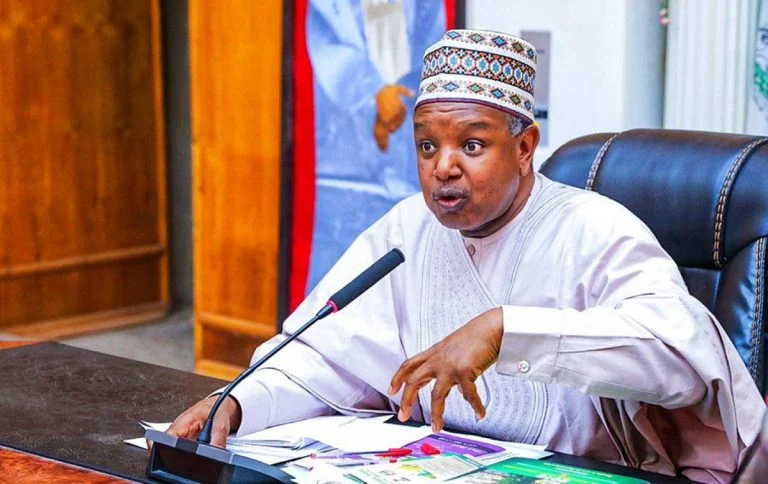
The Minister of Budget and Economic Planning, Atiku Bagudu, briefed State House correspondents after the Federal Executive Council meeting, describing the fiscal plan as “cautious but realistic,” with revenue for 2026 estimated at N50.74tn.
Revenue and Assumptions
Bagudu explained that the fiscal document is built on:
- Oil benchmark price: $64.85 per barrel
- Exchange rate projection: N1,512/$
- Crude production benchmark: 1.8 million bpd
- Production target for the industry: 2.06 million bpd
He said the dual production numbers provide a 12.6% safety buffer in case of output disruptions. Despite the cautious benchmarks, the minister expects the economy to grow by 4.68% in 2026, although pre-election spending may pressure the exchange rate.
He added that revenues will be shared as follows:
- Federal Government: N22.60tn
- States: N16.30tn
- Local governments: N11.85tn
The FG’s total revenue from all sources is projected at N34.33tn, including N4.98tn from government-owned enterprises.
Debt, Deficit and Rising Fiscal Pressures
With N15.91tn earmarked for debt servicing, the obligation will consume 29.2% of Nigeria’s entire 2026 budget, meaning the government will spend almost three out of every ten naira on servicing loans.
The proposed N20.10tn deficit amounts to 36.9% of total planned expenditure—more than double the N9.22tn deficit approved for the 2025 fiscal year.
In comparison, the amended 2022 budget under former President Muhammadu Buhari was N17.32tn, with debt service at N3.98tn. The 2026 figure is now 299% higher.
Experts Warn of Fiscal Instability
Economists who spoke to The PUNCH expressed concern that the rising deficit, ballooning debt service burden and late budget preparations could undermine Nigeria’s fragile macroeconomic stability.
“Nigeria risks falling into a debt trap” — Muda Yusuf
The CEO of the Centre for the Promotion of Private Enterprise said high deficit financing threatens inflation, exchange rate stability and private-sector activity.
He noted that Nigeria’s recent macroeconomic recovery may be wiped out if borrowing continues to rise unchecked.
“There is no basis for a new budget without implementing the old one” — Prof. Sheriffdeen Tella
A professor of Economics at Olabisi Onabanjo University criticised the timing of the 2026 budget, saying the government had “barely implemented the 2025 budget.”
He argued that Nigeria risks “operating multiple budgets within one year,” which he described as fiscal disorder.
“We are drifting away from the January–December cycle” — Prof. Adeola Adenikinju
The National President of the Nigerian Economic Society warned that Nigeria is again behind schedule, which undermines predictability and weakens investor confidence.
He also questioned the legality of running such a large deficit, noting that the Fiscal Responsibility Act limits budget deficit to 3% of GDP.
Call for Spending Discipline
Bagudu said the new framework incorporates feedback from ministries, the Economic Management Team and the National Economic Council, which recently endorsed:
- Greater alignment between fiscal and monetary policies
- Increased investment in security infrastructure
- Stronger efforts to curb revenue leakages in oil, gas and mining
The MTEF/FSP will serve as the foundation of the 2026 Appropriation Bill when it is transmitted to the National Assembly.