


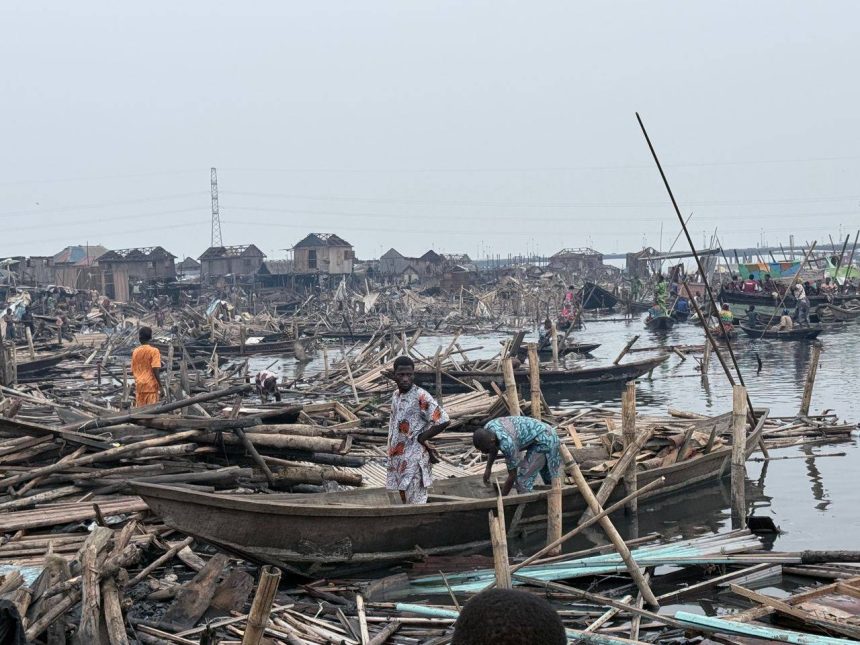
Residents of Makoko, Owode Onirin, and other Lagos waterfront communities are grappling with mass displacement following government demolition exercises described as “urban renewal,” which critics say disproportionately affect the poor.
Since December 23, 2025, over 3,000 homes have been destroyed, displacing more than 10,000 people in communities including Makoko, Oworonshoki, Ilaje-Otumara, Owode Onirin, and Baba Ijora. Women, children, and the elderly now find shelter in canoes, churches, and open spaces, stripped of security and livelihoods.
At a press briefing at the International Press Centre, Ogba, human rights and civic groups, including the #Endbad Governance Movement, CAPPA, and the Makoko Waterfront Community, condemned the state’s actions as inhumane. They accused authorities of prioritizing elite land interests over residents’ rights and livelihoods.
“Makoko is home to over 100,000 people. Families who have lived and worked here for generations now face homelessness,” said Israel Idowu, Coordinator of Makoko Waterfront Community. Reports indicate that at least 12 people, including two infants, died during the demolitions.
Residents like Funke Adeyemi, a 38-year-old fisherwoman, described the impact on their lives:
“My parents lived here. My children were born here. My canoe is my office. Now I have no house, no school for my children, and no place to fish from.”
While Lagos State officials justify the demolitions as safety and environmental measures, critics argue that the government failed for decades to provide essential infrastructure and basic services, and is now using neglect as justification to clear land for elite projects.
Human rights groups also raised questions about a $200 million World Bank loan purportedly earmarked for slum upgrading, including Makoko, demanding transparency on its usage.
Community leaders emphasized that they support development but demand justice, compensation, and resettlement rather than demolition that displaces citizens and destroys communities.
Makoko’s plight reflects a broader debate in global urban planning, where informal settlements in cities like Nairobi and Cape Town are upgraded rather than demolished.