


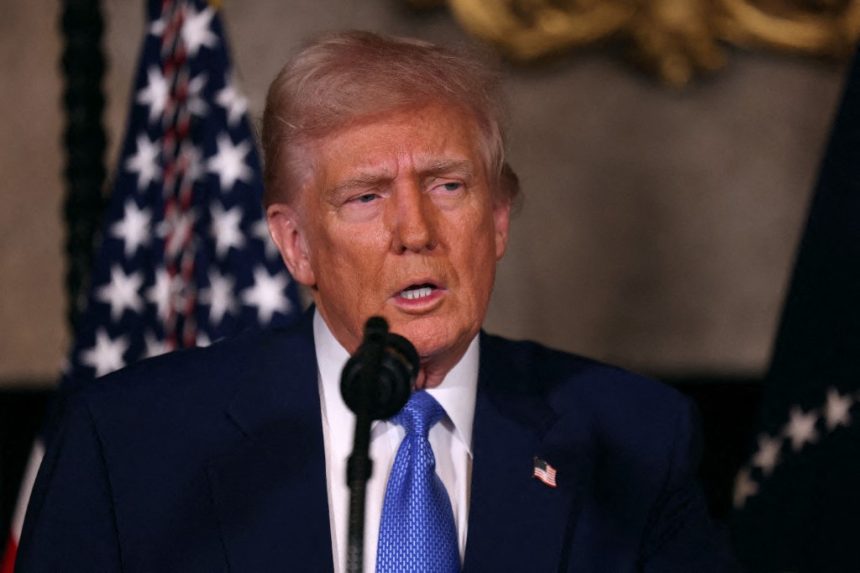
United States President Donald Trump has, for the first time, publicly acknowledged that Muslims are also victims of violent attacks in Nigeria, marking a notable shift from his earlier rhetoric that framed the country’s insecurity largely as a campaign against Christians.
Trump made the admission in a wide-ranging interview with The New York Times, even as he maintained his long-held position that Christians remain the primary targets of extremist violence in the country.
“I think that Muslims are being killed also in Nigeria. But it’s mostly Christians,” Trump was quoted as saying, repeating the statement when pressed further during the interview.
The remarks represent a partial retreat from the US president’s earlier stance, which had drawn criticism from Nigerian authorities and security analysts who argue that armed violence in the country cuts across religious lines and is driven largely by terrorism, banditry and criminal insurgency.
Trump’s comments come weeks after the United States carried out a Christmas Day military strike on terror targets in Nigeria, an operation Washington said was conducted at the request of the Nigerian government and aimed at Islamic State-linked militants operating in the country’s northwest.
Asked whether the strike marked the beginning of a broader military campaign, Trump suggested that further action remained possible.
“I’d love to make it a one-time strike,” he said. “But if they continue to kill Christians, it will be a many-time strike.”
The US president’s framing of Nigeria’s insecurity as primarily religious has been a point of contention. His senior Africa adviser had previously stated that extremist groups such as Boko Haram and the Islamic State West Africa Province had killed more Muslims than Christians over the years.
When confronted with that assessment, Trump acknowledged Muslim casualties but continued to emphasise Christian victimhood, a position that has fuelled debate over the accuracy and consequences of his characterisation.
In late October, Trump warned that Christianity faced what he described as an “existential threat” in Nigeria, a claim that coincided with his decision to redesignate the country as a “Country of Particular Concern” under US religious freedom laws. He accused the Nigerian government of failing to adequately protect Christian communities and threatened possible military intervention.
The Federal Government has repeatedly rejected allegations of a targeted religious genocide, stressing that violent attacks in Nigeria affect both Christians and Muslims and are largely driven by extremist and criminal groups rather than faith-based agendas.
Following Trump’s remarks and policy decisions, Nigeria dispatched a high-powered delegation to Washington to engage US officials and present what it described as a clearer picture of the country’s security challenges. That diplomatic engagement was later followed by visits to Nigeria by senior American officials seeking firsthand assessments of the situation.
Security experts have warned that oversimplifying Nigeria’s complex violence risks distorting policy responses and inflaming religious tensions in a country already grappling with fragile communal relations.
While Trump’s latest comments signal a slight moderation of his earlier claims, analysts say his continued emphasis on religious identity rather than broader security dynamics underscores the persistent gap between US political rhetoric and Nigeria’s lived reality on the ground.
