


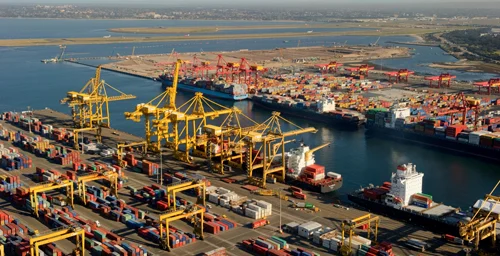
Nigeria’s heavy dependence on imported building materials is placing the country’s housing market at serious risk, according to the State of Lagos Housing Market Report (Volume 3). The report reveals that 70% of construction inputs are imported, leaving the sector highly vulnerable to global supply disruptions and currency fluctuations.
Despite Nigeria’s abundant raw materials, local processing remains insufficient to meet domestic demand.
The report calls for a multi-pronged strategy to strengthen the market, including: boosting local manufacturing, optimising supply chains, enforcing consistent policy reforms, adopting sustainable construction practices, and attracting both domestic and foreign investment. These measures aim to stabilise material costs, improve housing affordability, and address Nigeria’s persistent housing deficit.
Lagos, Nigeria’s most populous state and economic hub, reflects the broader national trends in the housing and construction sector. With rapid urbanisation and a growing population, demand for housing units, commercial spaces, and infrastructure is intensifying. Government investments in major projects, such as the Lagos Rail Mass Transit and road expansions, are also driving property values upward.
However, the report highlights ongoing challenges, including rising material costs, persistent inflation, bureaucratic delays, and high financing expenses. These factors are limiting the efficiency and affordability of housing development, even as the construction industry experiences robust growth. The sector is projected to expand at an annual rate of 8%, reaching NGN 25.72 trillion by 2025, and is expected to grow further to NGN 35.38 trillion by 2029.
Between 2015 and 2025, the cost of essential building materials in Lagos surged dramatically. For instance, prices of reinforcement steel (iron rods) nearly doubled from 2023 to 2025. A 12mm iron rod that cost N8,000 in May 2023 rose to N19,000 by May 2024, while a 16mm rod jumped from N4,800 to N11,500 in the same period. By 2024–2025, iron rods and aluminium products had almost doubled in price, placing significant strain on construction projects and home affordability.
The report underscores that addressing Lagos’s housing and construction challenges can serve as a blueprint for national reforms. By promoting local production, stabilising supply chains, and implementing policy and investment interventions, Nigeria can improve efficiency, reduce costs, and foster sustainable housing development.
Published by the Roland Igbinoba Real Foundation for Housing and Urban Development, the State of Lagos Housing Market Report, 3rd Edition, builds on insights from the first and second editions released in 2009 and 2016.
