


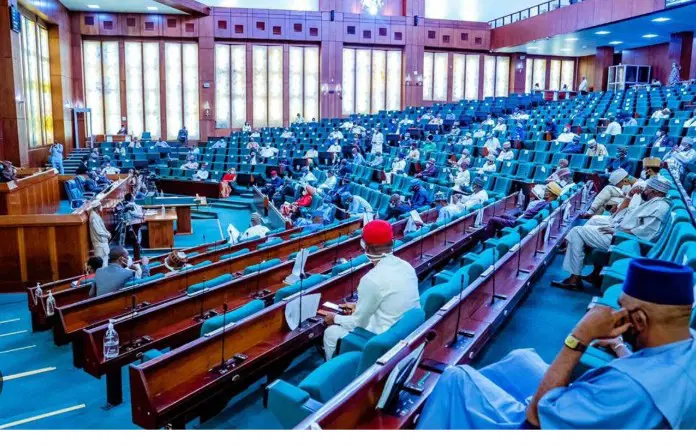
The House of Representatives has endorsed a proposal to establish Nigeria’s first dedicated Green and Climate Finance Bank, describing the initiative as critical to unlocking the country’s estimated $104 billion climate-smart investment potential by 2030.
Chairman of the House Committee on Renewable Energy, Hon. Afam Victor Ogene, announced the endorsement during a press briefing in Abuja alongside promoters of the proposed institution. He said the initiative aligns with the Federal Government’s renewable energy drive and Nigeria’s obligations under the Paris Agreement on climate change.
According to Ogene, Nigeria has significant climate-smart investment opportunities but continues to face a financing gap that hampers its energy transition and climate targets.
Citing data from the International Finance Corporation (IFC), he noted that the central issue is access to finance. Traditional commercial banks, he explained, often struggle to provide long-term and affordable capital for renewable energy and climate-focused projects due to risk perceptions and structural constraints. This has left many renewable energy developers and green entrepreneurs without adequate funding.
Privately Driven, Globally Aligned
Ogene clarified that the proposed Green and Climate Finance Bank would be privately driven and not government-owned. He added that it would operate under strong governance standards consistent with global environmental, social, and transparency frameworks.
He further revealed that the promoters have developed a comprehensive business plan and stakeholder engagement roadmap. He urged development partners, sovereign investors, pension funds, and institutional investors to support the initiative, stressing that Nigeria must strategically position itself in the global green transition.
$100 Million Initial Capital, 2027 Timeline
Co-founder of Quantum Partners Investments Limited, Mr. Oluwafemi Adedipe, said the bank is structured to mobilise capital at scale to support Nigeria’s transition to a low-carbon economy.
He pointed out that while Nigeria remains one of the most climate-vulnerable countries globally, it also represents a major green investment frontier. Key opportunities exist in renewable energy, climate-smart agriculture, green infrastructure, and circular economy ventures.
Dr. Samuel Ndubisi-Brown, a partner in the project, disclosed that promoters are raising $100 million in initial capital. The funds will be used to secure regulatory approvals, build digital infrastructure, and commence operations. He projected that the bank could begin operations in the first quarter of 2027, subject to approval by the Central Bank of Nigeria (CBN).
Focus on SMEs and Green Enterprises
Responding to questions, the promoters said the bank would primarily target small and medium enterprises (SMEs), renewable energy developers, mini-grid operators, and other climate-focused businesses rather than large corporations.
They explained that unlike climate funds, the proposed institution would be fully regulated and capable of directly lending to private businesses. The objective is to create a homegrown financing platform that can attract international capital while strengthening local institutional capacity to fund Nigeria’s climate transition.
The promoters emphasised that sustainable finance represents the future of banking, describing climate action not only as an environmental necessity but also as a long-term structural investment opportunity for Nigeria.