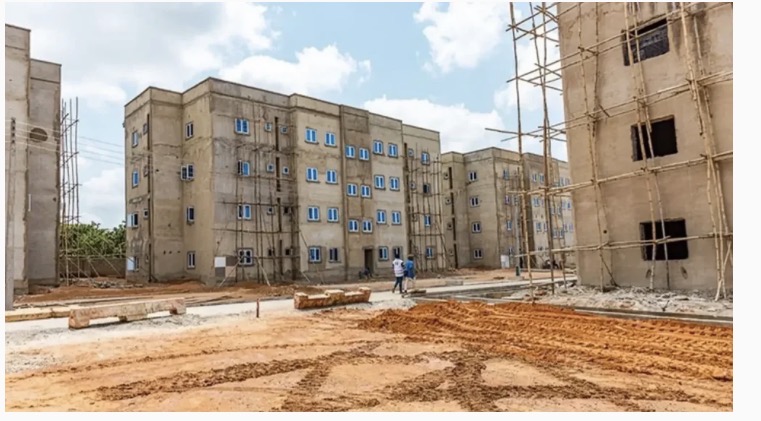
2027 Election: Parties Outline Different Plans for Nigeria’s Housing Sector
Nigeria’s housing sector is becoming a prominent issue ahead of the 2027 general elections, with political parties putting forward different proposals on land administration, mortgage finance, affordable housing, rental housing and construction costs.
The proposals are being presented against a backdrop of rapid urbanisation, rising development costs and limited access to affordable housing.
A Guardian report published on September 28 estimated Nigeria’s housing deficit at about 15 million units and reported that the country could require approximately 550,000 new homes annually, with about N5.5 trillion needed over the next decade to address the shortfall.
The housing debate is extending beyond the number of homes parties propose to build, with land costs, infrastructure, access to long-term finance, building materials, property documentation and rental housing also featuring in the various proposals.
Housing affordability becomes a major policy issue
The proposals examined by the Guardian focus on structural factors affecting the cost and availability of housing.
These include access to titled land, long-term mortgage finance, serviced land, rental accommodation, construction materials and private-sector investment.
The report noted that increasing housing supply alone does not necessarily make homes affordable because land, infrastructure, financing, building materials and approval costs all contribute to the final price of a property.
It also reported that cement prices had risen to about N14,500 to N15,000 per 50kg bag, while reinforcement steel was selling for between N1.2 million and N1.5 million per tonne, depending on location.
APC continues existing housing programmes
The All Progressives Congress, which currently controls the Federal Government, is continuing with the Renewed Hope Housing Programme, Federal Housing Authority estates and mortgage-related reforms involving the Ministry of Finance Incorporated and the Federal Mortgage Bank of Nigeria.
The government has previously set a target of delivering 100,000 homes nationwide.
According to the Guardian report, the first phase includes housing cities of 1,000 units each across the six geopolitical zones and the Federal Capital Territory, alongside estates of up to 500 units in the remaining 30 states.
The report said work had commenced on more than 3,000 units in Abuja, while a 2,000-unit housing city at Ibeju-Lekki, Lagos, had reached an advanced stage, with sales underway.
The government has also stated that more than 15,000 housing units are under construction nationwide.
Housing finance is another component of the current administration’s programme.
The government said 1,859 families across 25 states had secured mortgages worth N128 billion through the Ministry of Finance Incorporated Real Estate Investment Fund at a fixed interest rate of 9.75 per cent, repayable over 20 years.
The Federal Government has also proposed changes to the mortgage industry, including a National Housing Finance Authority and broader access to housing finance for workers in the informal sector.
SDP proposes three million affordable homes
The Social Democratic Party has proposed a National Affordable Housing and Sustainable Communities Programme.
Under the proposal contained in its manifesto, the party said it would seek to construct at least three million affordable housing units nationwide within four years through public investment, public-private partnerships and cooperative housing schemes.
The party said different housing models would be developed for various income groups and occupations, including low-income households, middle-income earners, young professionals, civil servants, artisans, farmers and senior citizens.
Its proposals also include mortgage-finance reforms, cooperative housing and employer-assisted housing.
Land administration forms another part of the SDP proposal.
The party identified delays in obtaining Certificates of Occupancy, unclear property rights, overlapping institutional responsibilities and lengthy registration processes as factors that can increase housing costs and discourage investment.
It proposed digital land registries, simplified property registration, transparent land allocation and modern cadastral systems in collaboration with state governments.
The proposed funding structure includes federal budget allocations, state counterpart funding, public-private partnerships, housing bonds, pension-fund investments, concessional development finance, diaspora investment and private capital.
PDP proposes social housing and land registry reforms
The Peoples Democratic Party is drawing on housing proposals contained in its 2023 policy agenda, according to the Guardian report.
Its proposals include a National Social Housing Fund, slum upgrading and 20-year mortgages at an interest rate of 10 per cent.
The party has also proposed reforms to land registries and the creation of a nationally interoperable system for transferable property rights.
The stated objective is to reduce transaction times, improve access to credit and increase transparency in property transactions.
The PDP has also proposed greater use of local building materials, mixed-income communities, public-private partnerships and a review of the Land Use Act to reduce the cost of acquiring land.
Other proposals include grants for site-and-services schemes, research into lower-cost building materials and measures to strengthen mortgage institutions.
AAC proposes N2m housing units and long-term mortgages
The African Action Congress has proposed affordable housing units at an average cost of N2 million per unit.
The party also proposed mortgage financing over 20 years at an interest rate of no more than 10 per cent.
According to the Guardian report, the party estimated annual repayments between N211,000 and N235,000 for the proposed N2 million units, depending on whether a 10 per cent deposit is made.
The AAC also proposed using government-owned land valued at $3.64 billion as seed investment for construction and to capitalise an investment fund open to Nigerians.
The proposals place land costs and long-term housing finance at the centre of the party’s housing approach.
ADC focuses on land, building materials and rental housing
The African Democratic Congress has included housing within a broader infrastructure, economic and social-policy agenda.
Its proposals cover mass social housing, land and finance reform, local production of building materials and rental housing.
The party has proposed faster land-title processing, lower land costs, serviced land and digitisation of land administration.
Its housing-finance proposals include mortgage reform, rent-to-own schemes, housing cooperatives and pension-backed financing.
The ADC has also proposed increased local production of cement, steel, roofing materials and tiles, alongside certified alternative building technologies.
It has linked construction costs to energy and transport expenses and proposed measures aimed at reducing those costs.
Rental housing also features in the party’s proposals, including greater institutional investment in rental properties and policies aimed at protecting both tenants and landlords.
NDC links housing to infrastructure and private capital
The National Democratic Congress has placed affordable housing and modern towns within its broader infrastructure and industrial-development agenda.
Its published 2027 manifesto summary identifies housing and urban planning alongside areas including power, roads, rail and ports, while proposing public-private partnerships as part of its wider economic strategy.
The party’s Lagos governorship candidate, Funso Doherty, has provided additional details of the approach, including government allocation of suitable land and efforts to increase the scale of housing development.
Doherty also proposed government guarantees to provide institutional backing for investors and lenders, alongside secondary mortgage finance to expand access to housing finance.
The approach places emphasis on creating land, financing and institutional frameworks for private-sector participation rather than relying solely on government-funded construction.
Land administration features across proposals
Despite differences among the proposals, land administration is a recurring issue.
Digital land registries, faster title processing, transparent land allocation, clearer property rights and improved cadastral systems feature prominently in several of the plans.
Land administration has implications for the property market because uncertainty over ownership and lengthy registration processes can increase transaction costs and make it more difficult to use property as collateral.
For developers, reliable land documentation can also affect project timelines, financing decisions and investment risk.
The proposals therefore place land reform alongside housing construction rather than treating it solely as an administrative issue.
Mortgage finance remains a central issue
Access to long-term finance is another recurring theme across the housing proposals.
The various plans include lower mortgage rates, longer repayment periods, rent-to-own arrangements, cooperative financing, pension-backed housing finance and secondary mortgage-market mechanisms.
The focus reflects the gap between residential property prices and household incomes.
For many potential homeowners, the challenge is not simply finding a house but being able to finance its purchase over a period that matches their income.
Mortgage availability also affects developers because a larger pool of qualified buyers can support the absorption of new housing developments, while limited mortgage access can push developers towards higher-income segments where buyers have greater purchasing power.
Construction costs remain a major constraint
The various proposals also recognise the role of construction inputs in determining housing affordability.
The Guardian report highlighted increases in cement and reinforcement steel prices, while the party proposals include local production, alternative building technologies, lower energy costs and improved transport infrastructure as possible ways to reduce construction costs.
For private developers, lower input costs could affect project viability and the prices at which new homes are brought to market.
The issue is particularly relevant to affordable housing, where relatively small increases in construction costs can push properties beyond the purchasing capacity of intended buyers.
Rental housing receives greater attention
Rental housing also features in several of the proposals.
The plans include rent-to-own schemes, institutional investment in rental housing and measures aimed at increasing affordable rental supply.
This reflects the fact that not every household can immediately qualify for a mortgage or afford to purchase a property.
A larger and more formal rental market could also create opportunities for institutional investors, pension funds and other long-term capital providers, depending on the regulatory and investment environment.
Implementation remains a key issue
The range of proposals places significant emphasis on policy frameworks, financing structures and institutional reforms.
However, the Guardian report highlighted implementation as a major issue for any administration seeking to address Nigeria’s housing shortage.
Delivering housing at scale requires land, infrastructure, finance, construction capacity and coordination across federal, state and local institutions.
Land administration is substantially influenced by state-level systems, while housing finance, infrastructure, planning and construction involve multiple federal and subnational institutions.
For developers and investors, implementation would therefore involve more than the number of units contained in a manifesto. Development-ready land, financing costs, infrastructure, regulatory certainty, construction economics and the purchasing power of intended buyers would also affect delivery.
Housing becomes part of the 2027 policy debate
The 2027 election cycle has brought housing policy further into the national political discussion, with parties proposing measures covering land administration, mortgage finance, affordable and rental housing, construction costs and private-sector investment.
The proposals differ in their targets, financing mechanisms and institutional approaches.
Across the plans, however, land costs, mortgage access, construction inputs, infrastructure and household affordability feature repeatedly as factors affecting housing delivery.
For Nigeria’s housing and real estate market, the proposals provide different approaches to the same broad policy areas, while their eventual implementation would depend on the institutional, financial and economic conditions surrounding housing delivery.