
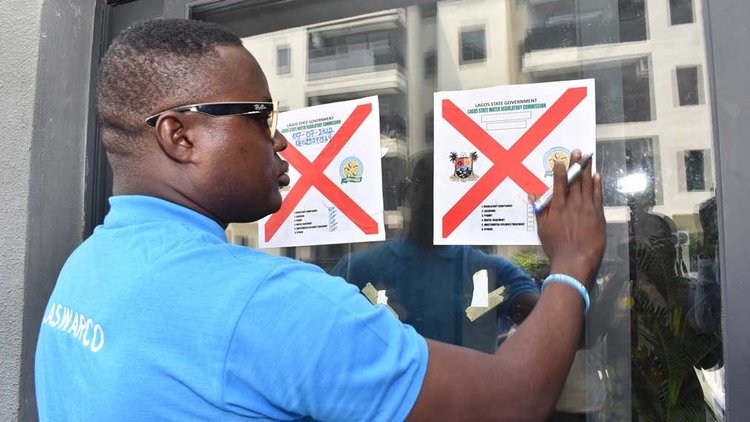
The Lagos State Government, through the Lagos State Wastewater Management Office (LSWMO), has officially sealed a residential estate at No. 96 Ladipo Omotesho Street, Lekki Phase 1. The action, carried out on Wednesday, January 7, follows persistent environmental violations and obstruction of state officials in the discharge of their duties.
According to the General Manager of LSWMO, Engr. Adefemi Afolabi, the decision to shut down the estate was not abrupt.
The estate had been served multiple notices over the past months for indiscriminate discharge of untreated wastewater and poor sewage management.
These violations pose significant health risks to the Lekki community and undermine ongoing efforts to maintain public sanitation standards.
Infractions Cited by LSWMO
The regulatory office listed several breaches that prompted the enforcement action:
Wastewater Mismanagement: The estate has consistently discharged untreated sewage into public spaces, threatening groundwater quality and the health of residents in the vicinity.
Obstruction of Justice: Residents and estate facility managers reportedly interfered with LSWMO officers attempting routine compliance inspections.
Non-Compliance: Despite repeated statutory notices, the estate failed to remedy the identified environmental infractions.
Engr. Afolabi emphasized that the estate will remain sealed until all violations are fully rectified and verified. He warned that the government will adopt a zero-tolerance approach to any interference with authorized officers, stressing that public health takes precedence over private convenience.
Part of a Broader Enforcement Drive
This enforcement is part of a wider mandate for 2026 under the Commissioner for Environment and Water Resources, Tokunbo Wahab, aimed at ensuring the environmental sustainability of Lagos’s real estate sector. The LSWMO has signaled that all residential and commercial properties must maintain proper sewage treatment systems and comply with environmental regulations.
This is not an isolated case. In September 2025, the LSWMO sealed EMCEL Court Phase I and Well Stock Apartments in Ikota GRA for similar infractions. These actions demonstrate the state government’s determination to enforce environmental laws uniformly across high-end areas such as Lekki, Ikoyi, and Victoria Island.
Implications for Property Owners and Investors
The sealing has significant implications for the real estate market, particularly for property owners and investors:
Increased Scrutiny: Prospective buyers and investors are now prioritizing estates with certified Wastewater Treatment Plants (WWTP) and verified environmental compliance.
Regulatory Risk: Sealing of a property can lead to immediate loss of rental income, potential fines, and reputational damage to the estate’s brand.
Compliance as a Market Standard: Environmental Compliance Certificates are becoming as essential as land titles, especially for high-end residential developments.
Experts warn that estates failing to maintain proper wastewater management may experience lower occupancy rates, reduced property values, and heightened scrutiny from regulatory agencies. This development signals a broader shift in Lagos’s real estate sector, where compliance with environmental laws is increasingly tied to financial and reputational performance.
Community Engagement and Reporting
The LSWMO has urged residents to actively participate in the “Green Lagos” initiative by reporting illegal sewage disposal or environmental violations. Citizens are encouraged to report infractions via the following hotlines: 08022022397 or 07025332163.
By involving the community in monitoring compliance, the government aims to create a culture of accountability and environmental stewardship, ensuring that private estates adhere to public health standards.
Looking Ahead
The Lekki Phase 1 case serves as a stark reminder that no estate is above the law, and persistent non-compliance will attract stringent enforcement measures. For property developers, managers, and residents, the directive underscores the importance of proactive environmental management, robust wastewater infrastructure, and cooperation with regulatory authorities.
As Lagos continues to modernize its real estate and infrastructure sector, environmental compliance is becoming a critical determinant of market value, investor confidence, and public safety. Stakeholders are now expected to integrate environmental risk management into the core operations of residential estates to avoid similar sanctions.