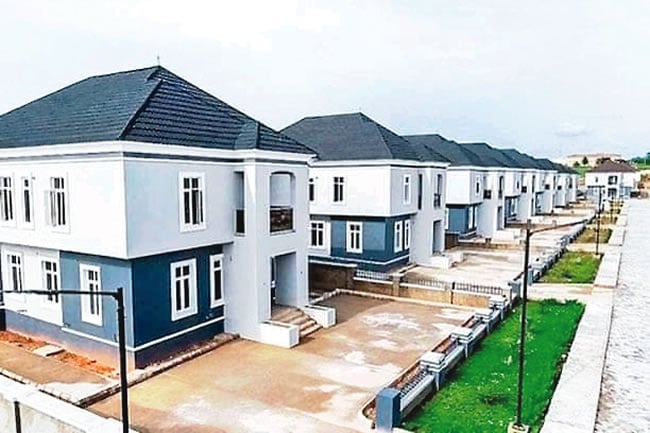
A real estate development expert, Dr Meckson Innocent Okoro, has called on the Federal Government and state governments to adopt direct land allocation as a deliberate policy tool to reduce the cost of mass housing delivery across Nigeria.
Okoro said affordable housing would remain unattainable for many Nigerians unless governments take greater responsibility for land provision and supporting infrastructure, particularly for large-scale housing estates located outside urban centres.
He identified land, finance and infrastructure as the three most critical components of housing delivery, stressing that the absence of any of these elements significantly increases the final cost of housing units.
According to him, when governments directly allocate land for housing projects and provide basic infrastructure such as access roads, electricity, water supply and mass transit systems, developers are able to deliver homes at significantly lower prices.
“Easy and affordable transportation will encourage people to buy and live in these estates, especially when they are far from city centres. Government involvement in infrastructure development will drastically reduce the selling price per housing unit,” he said.
Commends Renewed Hope Estates initiative
Okoro made the remarks while commending the Federal Government under President Bola Ahmed Tinubu for initiating the Renewed Hope Estates and Cities Programme, describing it as a major step towards closing Nigeria’s housing gap.
He noted that the initiative marks one of the closest attempts Nigeria has made toward structured mass housing delivery comparable to global best practices.
The former Publicity Secretary of the Nigerian Institution of Estate Surveyors and Valuers (NIESV) also praised the administration for aligning housing delivery with long-term mortgage financing, including a 20-year tenure, single-digit interest rates, and a 10 per cent equity contribution by subscribers.
“This is a commendable intervention aimed at giving ordinary Nigerians access to homeownership,” he said.
However, Okoro cautioned that the success of the programme would depend on its continuity beyond the lifespan of the current administration.
He urged the Ministry of Housing and Urban Development to institutionalise the strategy, gather data from ongoing projects and refine future housing policies based on feedback from beneficiaries.
Infrastructure, solar power critical
Speaking further on mass housing development, Okoro warned that leaving developers to independently provide roads, electricity and water often leads to inflated housing costs.
He advocated for government-led infrastructure provision and encouraged the incorporation of solar energy solutions in all federal housing estates to reduce long-term energy costs.
“I also suggest that solar panels should be integrated into every federal housing estate so subscribers do not resort to generators, which increase cost and environmental impact,” he said.
Concerns over mortgage access
On funding, Okoro expressed concern about the ease of accessing mortgage facilities under the Renewed Hope Estates programme, particularly through the MOFI Real Estate Investment Fund (MREIF).
While applauding the availability of mortgage funding, he warned that delays and bureaucratic bottlenecks by disbursement banks could undermine the initiative.
“My concern is how accessible these mortgage funds are to subscribers. Government must ensure that appointed banks do not create unnecessary delays in fund disbursement,” he said.
He called on the Central Bank of Nigeria (CBN) to carry out regular supervision of mortgage disbursement banks to ensure strict compliance with established guidelines.
Drawing lessons from the failed mortgage reforms of the early 1990s, Okoro warned that weak regulation could derail even well-intentioned housing policies.
“No matter how noble the intention, mortgage schemes only succeed when there are strong checks and enforcement mechanisms,” he said.
Clean land titles, anti-speculation measures urged
Okoro further stressed that all Renewed Hope Estate sites must have clean and verifiable land titles, noting that banks would be reluctant to finance properties with disputed ownership.
He also called for strict safeguards to prevent speculative purchases by government officials and politically connected individuals.
“In the past, mass housing schemes meant for ordinary Nigerians ended up in the hands of a few privileged individuals who later resold them at higher prices,” he said.
According to him, effective checks and balances are required to ensure that the houses reach the intended beneficiaries.
Economic benefits for states
The real estate expert argued that sustained mass housing delivery would generate long-term revenue for state governments through ground rents and land use charges.
“If the government succeeds in delivering millions of houses over time, states will benefit from consistent property-related revenues. Without housing development, these income streams are lost,” he added.