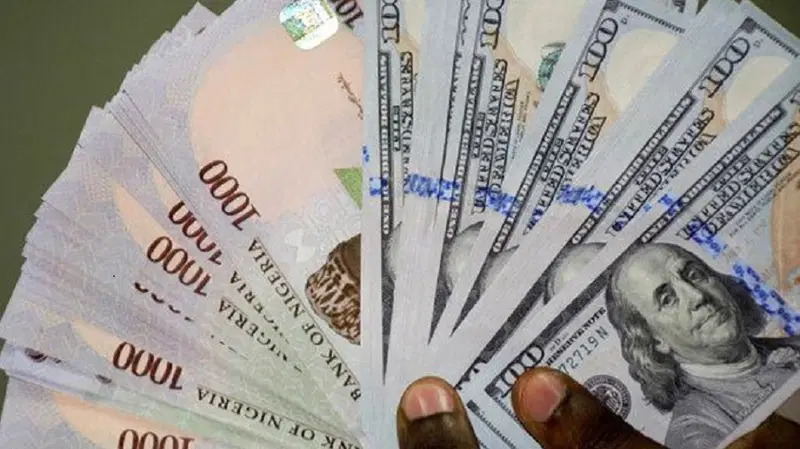
The naira closed the week slightly weaker at the official foreign exchange market, settling at N1,421.9 per dollar, despite a softer U.S. dollar in global markets.
Data from the Central Bank of Nigeria (CBN) shows that domestic dollar supply constraints continued to outweigh supportive external conditions, keeping pressure on the local currency throughout the trading week.
Although the naira avoided sharp volatility, it failed to sustain early-week gains, reflecting persistent distortions in Nigeria’s foreign exchange market.
At the official window, the naira closed at N1,421.9/$ on Friday, compared to N1,421.5/$ on Thursday and N1,423/$ on Wednesday. Earlier in the week, the currency traded at N1,420/$ on Tuesday and N1,420.5/$ on Monday, after opening at N1,425/$.
Compared with the previous week’s closing rate of N1,417.95/$, the naira ended the week marginally weaker.
In the parallel market, the naira depreciated slightly to N1,491/$ on Friday, from N1,490/$ the previous day. Weekly trading ranged between N1,483 and N1,491 per dollar, widening the gap between the official and street markets to about N70/$.
A Lagos-based currency trading expert, Dayo Omole, attributed the divergence to ongoing supply challenges.
“Nigeria has restrictions on foreign currency access and a limited dollar supply, so the naira may not strengthen significantly in the parallel market,” Omole said.
He noted that movements in the global dollar do not always translate into gains for the naira, as domestic supply-demand dynamics often dominate price action.
“When the dollar weakens globally but Nigeria continues to struggle with FX supply, the gap between official and parallel market rates can widen further,” he added.
Nigeria’s foreign exchange market has remained under strain following years of FX controls, multiple exchange rate regimes, and weak dollar inflows.
Despite recent reforms by the CBN aimed at improving transparency and market efficiency, structural challenges continue to affect liquidity and price discovery.
FX supply has remained constrained due to weaker oil export receipts, subdued foreign portfolio investment, and inconsistent diaspora remittances. The persistent gap between official and parallel market rates reflects unmet demand and lingering confidence issues among market participants.
Meanwhile, Nigeria’s external reserves stood at $45.9 billion last week, according to the CBN, providing some buffer for currency management.
The International Monetary Fund (IMF) recently upgraded Nigeria’s 2026 economic growth forecast to 4.4 per cent, citing optimism around ongoing economic reforms.
However, analysts note that geopolitical risks and policy uncertainty in the United States continue to add volatility to global FX markets, indirectly affecting frontier currencies such as the naira.