By Daniel Ayantoye
Copy-edited by Housing TV Africa Editorial Desk
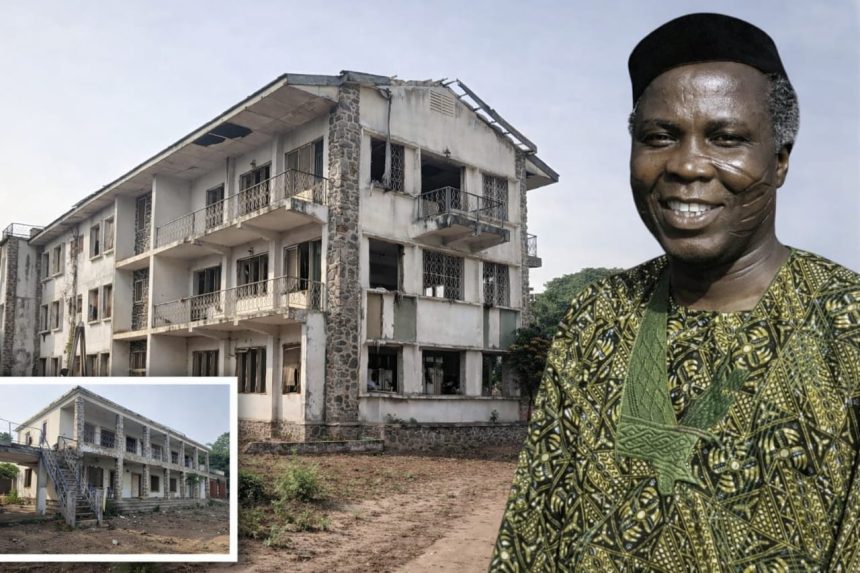
The once-prestigious residence of Chief Samuel Ladoke Akintola, Western Nigeria’s last premier, now lies in ruins at Oke-Ado, Ogbomoso, silently bearing witness to decades of neglect, vandalism, and fading political history.
On Wednesday, January 21, 2026, a visit to the estate—located about 222 kilometres from Lagos—revealed a property that has lost nearly all traces of its former glory. The compound, once a centre of political power and social activity, is today marked by broken gates, stripped buildings, and overgrown vegetation.
At the entrance, one of the twin metal gates has been forcibly cut open. Inside, both the two-storey main building and a single-storey structure have been heavily vandalised. Burglar-proof bars, louvre windows, pipes, and fittings have been removed, while roofs and ceilings have collapsed in several sections.
Originally, the two-storey building housed about 12 large rooms and six halls designed for meetings and gatherings. The adjoining single-storey structure contained six rooms and attached car parks. Today, faded walls, exposed ceilings, and debris-filled corridors define the estate.
Within the compound are the graves of Chief Akintola, his wife, Faderera Aduke Akintola, and their son, Olatokunbo Akanni Akintola, who died before his father. Behind the main building sits an Olympic-size swimming pool, now dry and filled with dirt, its pipes long removed by scavengers. A small cassava farm occupies part of the grounds.
Inside the rooms, broken picture frames, scattered books, old photographs, and abandoned furniture lie on the floor. Former kitchens and toilets have been completely stripped, leaving bare walls and empty spaces. Thick shrubs and spider webs block access to some parts of the buildings.
Despite the extensive damage, the structure itself remains firm, reflecting the quality of materials used during its construction.
A security guard stationed at the property confirmed that guards now work in shifts to secure the premises but declined further comment, citing lack of authorisation.
A Leader and His Legacy
Born in February 1910, Samuel Ladoke Akintola was a lawyer, journalist, and politician who became the second and last Premier of the old Western Region. He was also the 13th Aare Ona Kakanfo of Yorubaland and a prominent figure in Nigeria’s early political history.
Akintola was assassinated during Nigeria’s first military coup on January 15, 1966. He was survived by six children, three of whom are still alive, including Ambassador Abayomi Akintola, Dr Bimbo Akintola, and Justice Ladiran Akintola of the Oyo State High Court.
How the Estate Fell Apart
Farmers currently working on parts of the land say vandalism escalated after the property became largely unoccupied. Moses Adegoke, who has farmed on the estate for about four years, said looters usually strike when no one is around.
“We try to keep watch when we are here, but once we leave, more items disappear. Pipes, iron bars, fittings—almost everything has been taken,” he said.
Neighbours recalled that the residence once hosted political meetings, community events, and annual remembrance gatherings that brought life to the area. When these activities stopped, the estate gradually became exposed to vandals.
University Takes Over
The Samuel Ladoke Akintola Memorial Foundation confirmed that the property has been handed over to the Ladoke Akintola University of Technology (LAUTECH).
According to the university’s Vice-Chancellor, Prof. Razaq Kalilu, LAUTECH formally took possession of the estate in late 2024 under a lease agreement with the Akintola family. The lease was later extended from 10 to 30 years after an assessment revealed the scale of renovation required.
He said funds have been included in the institution’s 2026 budget to begin rehabilitation works, with plans to relocate the Institute of African Studies to the site. Security has also been strengthened to prevent further vandalism.
A Home Waiting for Renewal
Today, the abandoned estate stands as a stark reminder of how history can fade when heritage is left unprotected. Yet, with the involvement of LAUTECH and renewed security, there is cautious optimism that the property may be restored—not only as a functional space, but as a preserved symbol of Yoruba political history.
Editorial Note:
This report has been professionally copy-edited for print publication, originality, clarity, and structure.
Original reporting by Daniel Ayantoye.
Copy-edited by Housing TV Africa Editorial Desk.