The Federal Government has warned that poor workmanship, substandard building materials and the activities of unqualified practitioners could undermine efforts to expand access to safe and affordable housing across Nigeria.
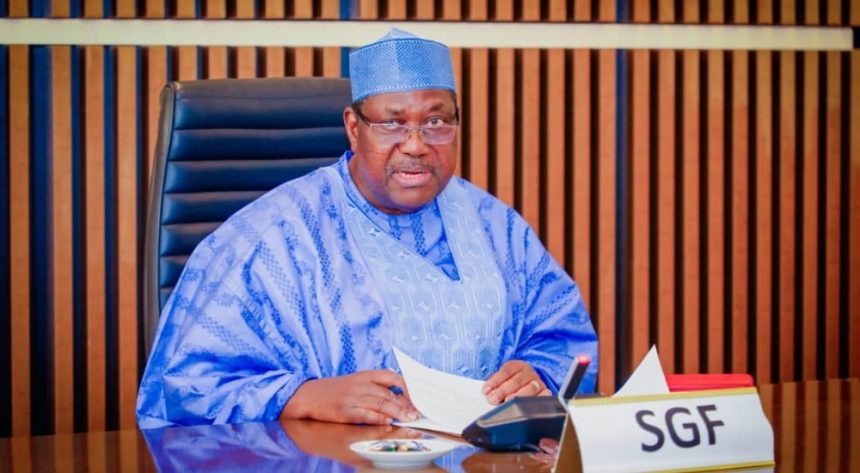
Secretary to the Government of the Federation (SGF), Senator George Akume, gave the warning in Abuja while chairing the 56th Annual Conference of the Nigerian Institute of Building (NIOB), themed “Repositioning the Building Profession, Advocacy and Policy Influence in Housing Delivery for a Sustainable Built Environment.”
Akume said Nigeria’s housing challenge required more than increasing the number of buildings constructed. He stressed that housing delivery must also focus on safety, affordability, durability and compliance with professional standards.
According to him, housing has implications beyond physical structures, as it affects household security, dignity, family stability, quality of life and the ability of Nigerians to build wealth.
The SGF identified several factors contributing to building failures in the country, including non-compliance with approved specifications, inadequate quality control, improper construction techniques, foundation problems and weak supervision on building sites.
He also warned certified builders against allowing their professional names or seals to be attached to projects they had not supervised. Such practices, he said, could weaken professional accountability and expose occupants to serious risks.
Akume called for greater public education on the consequences of poor construction, noting that defective buildings can result in substantial financial losses as well as loss of lives.
The government official also pointed to affordability as a major barrier to home ownership. Rising construction costs, he said, have made decent housing increasingly difficult for many Nigerian households to afford.
To address the cost challenge, Akume said the Federal Government was supporting the production of building materials across Nigeria’s six geopolitical zones. The initiative is aimed at increasing domestic production and helping to reduce construction costs.
He urged building professionals to contribute their technical knowledge, research capacity and industry networks to government housing policies and programmes from the design and planning stages through implementation.
Akume also encouraged professionals to work through consortia, introduce auditable quality-management systems, improve the training and certification of artisans, and deepen collaboration with government and reputable private developers.
Representing the Minister of Housing and Urban Development, Muttaqha Darma, the Director of Public Buildings, Musa Abdullahi, said recurring building collapses remained a serious concern for the construction industry.
Darma stressed the responsibility of builders in ensuring that construction activities comply with established engineering standards. He highlighted quality control, proper testing of materials and effective site supervision as important safeguards against construction failures.
He urged participants at the conference to develop practical recommendations capable of improving housing delivery and addressing persistent weaknesses within the sector.
Earlier, NIOB President Daniel Kolade said the institute was using advocacy and policy engagement to strengthen the building profession, improve construction standards and increase public awareness of the importance of hiring qualified professionals.
Kolade also identified quackery as a major challenge in the construction sector and advised Nigerians to engage properly qualified professionals when undertaking building projects.
The concerns raised at the conference come as Nigeria continues to grapple with the twin challenges of housing affordability and construction quality. For the housing sector, improving access to homes will therefore depend not only on increasing supply but also on stronger professional oversight, better materials, effective regulation and construction practices that protect the long-term value and safety of buildings.