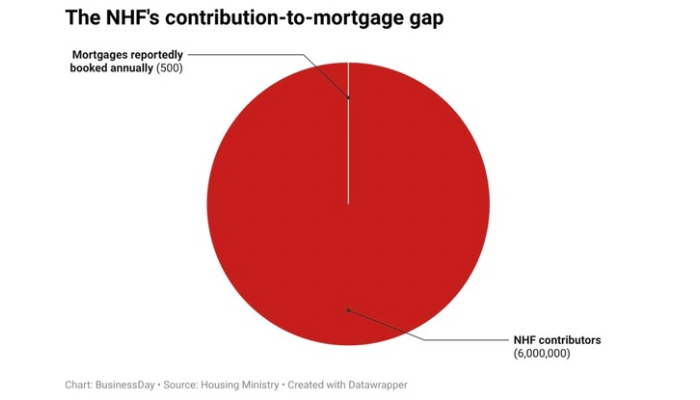
Six Million NHF Contributors, Fewer Than 500 Mortgages: Nigeria’s Homeownership Gap
Nigeria’s National Housing Fund has continued to attract billions of naira from workers, but the number of contributors successfully obtaining mortgages remains extremely low.
Housing and Urban Development Minister, Muttaqha Rabe Darma, recently said about six million Nigerians contribute between ₦120 billion and ₦150 billion to the fund annually, while the Federal Mortgage Bank of Nigeria books fewer than 500 mortgages.
Based on those reported figures, only a tiny proportion of contributors secure a mortgage each year, raising concerns about the fund’s ability to convert workers’ savings into widespread homeownership.
Established in 1992, the NHF requires eligible workers to contribute 2.5 per cent of their basic monthly salary. The funds are administered by FMBN and channelled into housing finance.
Under the current scheme, contributors may obtain up to ₦50 million through accredited primary mortgage banks after making continuous contributions for at least six months. The loans attract six per cent interest and can be repaid over a maximum of 30 years.
Although these terms are substantially cheaper than commercial mortgage rates, the price of housing remains beyond the repayment capacity of many workers.
A ₦50 million mortgage at six per cent over 30 years would require a monthly repayment of approximately ₦300,000, excluding insurance, documentation and other ownership expenses. This is more than four times Nigeria’s ₦70,000 national minimum wage.
The fund has also introduced home-renovation loans, construction finance, rent-to-own arrangements and a mortgage product for Nigerians in the diaspora.
However, differences in published beneficiary figures create further questions. While fewer than 500 mortgages are reportedly booked, broader estimates suggest that fewer than 20,000 Nigerians access various NHF-backed loans annually. These figures may cover different products and periods, underscoring the need for clearer reporting.
FMBN’s proposed National Mortgage Registry could improve transparency by tracking applications, approvals, disbursements, active loans and completed housing units.
Beyond affordable interest rates, experts say the NHF’s impact will depend on reducing land, infrastructure, building-material and construction costs.
The future performance of the scheme should therefore be measured not only by how much money it collects, but by how many contributors receive affordable homes with repayments that correspond to their incomes.