


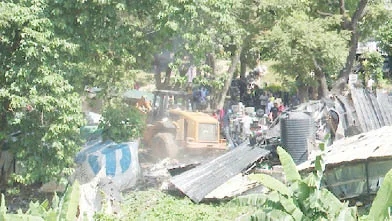
Traders and workers at the popular Yahuza Suya outlet near the National Mosque in Abuja are counting their losses after the demolition of the premises on Wednesday.
The demolition affected the Yahuza Suya outlet as well as other structures reportedly operating around the area, including River Plate and Hadiza Balangu.
Some businesses in the vicinity, including IBRO Fish, were reportedly not affected by the exercise.
The demolition was carried out by the enforcement team of the Federal Capital Territory Development Control Department, according to a sector monitor of the agency, Chinedu Okoro.
Traders Dispute Notice Claim
Affected traders said the demolition came without adequate warning.
Several occupants alleged that enforcement officials arrived at the premises in the early hours with heavy machinery and security personnel before commencing the exercise.
They claimed they were given only about five minutes to remove their belongings.
Gambo Musa, one of the affected traders, said the development caught the occupants by surprise.
According to Musa, the traders were unable to remove several items, including refrigerators, yoghurt and other fresh food products, before the structures were pulled down.
He also alleged that security personnel used tear gas during the exercise.
The allegation has not been independently established, and no official account cited in the report confirmed the use of tear gas.
Musa appealed to the authorities to consider the effect of the demolition on workers and their families.
He said the business provided employment for more than 100 people.
Workers Say They Were Not Given Enough Time
Another worker, Umar Bello, an assistant accountant with the company, said the officials did not adequately explain the reason for the demolition to those at the premises.
Bello said the occupants would have complied with an evacuation directive if they had been given sufficient time.
“It’s better to tell me three days, or two days, or one day,” he said.
Aliyu Idris, another worker, similarly alleged that Development Control officials arrived with enforcement personnel and a bulldozer before the demolition.
He said workers at the location were not aware of any notice preceding the exercise.
Idris appealed to the government to consider the impact of the demolition on workers and small businesses operating around the premises.
Association Chairman Raises Concern
The chairman of the Yahuza Chicken Sellers Association of Nigeria, Shittu Danladi, described the demolition as a major setback for traders operating under the Yahuza brand.
Danladi said he had been involved in the suya business in Abuja for decades.
He estimated that the affected branch had more than 150 workers, apart from people operating ancillary businesses around the premises.
Those businesses included food sellers and point-of-sale operators, according to Danladi.
He urged authorities to provide businesses with adequate notice before demolition exercises.
Danladi said traders were prepared to comply with government directives if they were properly informed and given sufficient time to evacuate.
Foreign Business Operator Appeals For Consideration
Ayisa Natalia, a Niger Republic national who operated a business at the premises, also expressed concern over the demolition.
Natalia said she had lived in Nigeria for about 14 years and had operated her business at the location for several years.
She said she was informed at about 8am that the premises was being demolished and subsequently rushed to the location.
According to her, the occupants had little time to remove their belongings.
Natalia appealed to the authorities to consider the livelihoods of the people who depended on businesses operating at the site.
FCT Gives Different Account
The FCT Development Control Department provided a different account of the circumstances surrounding the demolition.
Chinedu Okoro, a Sector Monitor of the department, confirmed that the agency’s enforcement team carried out the exercise.
Okoro said the demolished site was an allocated residential plot that had been converted for commercial use.
He also disputed the traders’ claim that they received only a few minutes’ notice.
According to the official, the occupants had been given more than six months to vacate the site.
“It is a residential plot used for commercial activities that the owner decided to take possession of. They were compensated and over six months’ notice was given to them before the exercise commenced,” Okoro said.
The official explanation provides a significant contrast with the account given by the affected traders, who said they were not presented with adequate written notice immediately before the demolition.
The report does not independently establish the precise date or form of the alleged six-month notice, nor does it provide documentation of the compensation referenced by the FCT official.
Dispute Centres On Land Use And Notice
The demolition therefore appears to centre on two separate issues: the approved use of the property and the amount of notice given to occupants before enforcement.
The FCT official maintains that the site was a residential allocation being used for commercial activities and that the occupants had been compensated and given more than six months to leave.
The affected traders, meanwhile, said they were not adequately informed before the demolition and complained about the limited time they had to remove their belongings.
The competing accounts have not been resolved by an independent finding in the information available for this report.
The incident has also raised concerns among affected workers about the immediate impact on their livelihoods.
For the traders, the demolition means the loss of a business location and, according to their representatives, disruption to the income of workers and ancillary operators who depended on the premises.
For the FCT authorities, the exercise forms part of enforcement of land-use regulations involving a residential plot that was allegedly being used for commercial purposes.
As of the latest account, the FCT Development Control Department had confirmed responsibility for the demolition, while the affected traders continued to appeal for clarification and consideration of their livelihoods.
The competing claims over notice and compensation remain central to the dispute.