


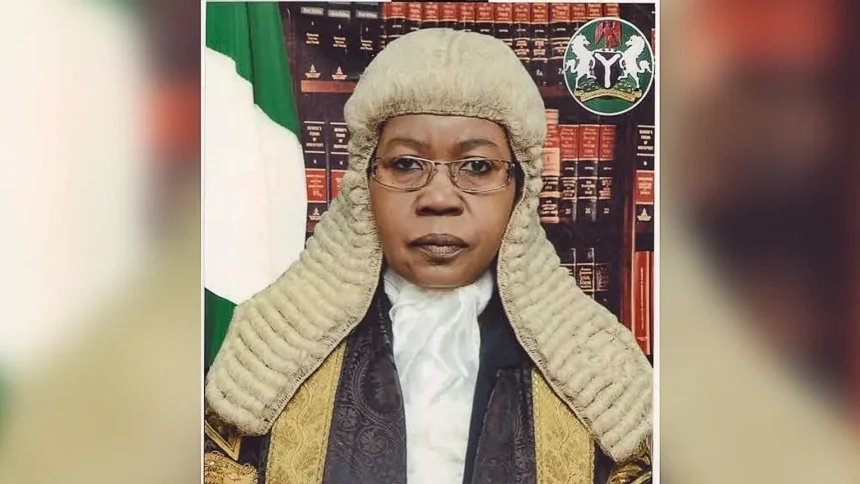
Retiring Supreme Court Justice Uwani Musa Abba-Aji has disclosed that seven justices who served on a controversial panel remain under United States travel restrictions following a disputed judgment.
Abba-Aji made the disclosure on Friday during a valedictory session held in her honour at the Supreme Court in Abuja.
Reflecting on her judicial career, she said some decisions exposed members of the Bench to personal challenges and public criticism.
She identified the controversy surrounding one judgment as a major challenge, alleging that widespread misinterpretation of the ruling led to the US imposing travel restrictions on all seven panel members.
“My time on the Supreme Court bench was filled with challenges, some of which have served as additional opportunities to stand firm on the side of justice, regardless of the consequences.
“One of such challenging judgments was widely misinterpreted and led to a travel ban to the United States of America being imposed on all members of the panel, a ban which still holds today,” she said.
Although Abba-Aji did not identify the judgment, her remarks were linked in the report to the Supreme Court’s January 14, 2020 decision that overturned Emeka Ihedioha’s election as Imo State governor and declared Hope Uzodimma the winner.
The seven-member panel included Abba-Aji, current Chief Justice of Nigeria Kudirat Kekere-Ekun and former Chief Justice Ibrahim Tanko Muhammad.
The ruling generated controversy after the Supreme Court accepted results from 388 polling units that were initially excluded from the final collation of the 2019 governorship election.
The court directed that votes claimed by Uzodimma in the affected polling units be added to the results earlier announced by the Independent National Electoral Commission (INEC). The adjustment resulted in Uzodimma’s emergence as governor.
The decision attracted criticism from opposition figures and members of the public, with questions raised about the additional votes and the reversal of the earlier declaration in Ihedioha’s favour.
Former Cross River State Governor Donald Duke had also alleged in 2023 that the seven justices were denied US visas when they sought to attend a judicial conference.
According to Duke’s allegation, members of the justices’ entourage who applied for visas received approval, while the judicial officers were denied entry permits.
Abba-Aji also recounted a separate experience in 2016 when she attended a programme in Washington, DC.
She said she received a telephone call requesting her appearance before the Economic and Financial Crimes Commission (EFCC) over a petition filed against her in Lagos.
The former justice said she visited the commission several times to respond to questions concerning corruption allegations, which she maintained she knew nothing about.
She added that the EFCC eventually cleared her after completing its investigation.
However, she described the period as difficult because damaging claims circulated publicly while judicial convention restricted her ability to defend herself openly.
Despite the experiences, Abba-Aji maintained that judicial officers must uphold the law even when their decisions attract criticism or personal consequences.
“Such inconveniences were a price to pay to preserve the chastity of justice,” she said.
She urged younger judges to maintain integrity and approach their responsibilities with humility and courage.
She also reminded serving judicial officers that the law was not merely a profession but a trust.
At the valedictory session, Chief Justice Kekere-Ekun praised Abba-Aji’s contributions to the judiciary, describing her years of service as significant to the legal profession and women aspiring to leadership positions on the Bench.
The Chief Justice described the retiring justice as leaving behind an unblemished record of service.
The Attorney-General of the Federation and Minister of Justice, Lateef Fagbemi, also commended Abba-Aji for her contributions to Nigeria’s legal system.
Fagbemi particularly acknowledged her role in a judgment that led to the establishment of key anti-corruption institutions, including the EFCC, the Independent Corrupt Practices and Other Related Offences Commission and the Nigerian Financial Intelligence Unit.
Abba-Aji is retiring from the Supreme Court on November 7, having attained the mandatory retirement age of 70.
She was the first female judge from Yobe State and the second female Supreme Court justice from the North-East geopolitical zone.