


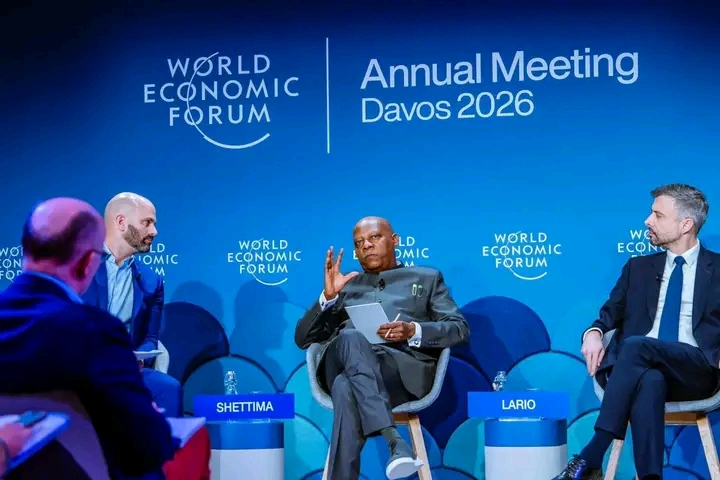
Vice President Kashim Shettima has highlighted the Dangote Refinery as a key driver in transforming Nigeria into a net exporter of refined fuel, emphasizing the need for African nations to rely on homegrown solutions for economic growth.
Speaking at a High-level Accra Reset Initiative meeting during the 2026 World Economic Forum in Davos, Switzerland, Shettima said Africa’s prosperity must be built locally, not imported from abroad. He described the initiative as a bold effort to reset African economies from “dependency to dignity, from aid to investment, from rhetoric to results.”
Shettima pointed out that decades of relying on commodity exports had left many African countries vulnerable. “Africa cannot rise on applause alone. We rise when we build,” he said. “After decades as a net importer of value, Nigeria is on the verge of becoming a net exporter of refined fuel, powered by Africa’s largest refinery in Lagos: the Dangote Refinery.”
He stressed that domestic productive capacity is essential to converting Africa’s population and natural resources into sustainable wealth. “Prosperity cannot be parachuted in — it must be homegrown and earned,” Shettima added, highlighting Nigeria’s market of over 200 million people as an example of latent demand that must be matched with local supply.
Shettima also pointed to technology, modular factories, artificial intelligence, and robotics as tools to help Africa industrialize faster than ever before. Citing 2024 data, he noted that Africans abroad sent home about $95 billion — more than 5% of Nigeria’s GDP — emphasizing that this is not charity but evidence of the continent’s untapped potential.
Former President Olusegun Obasanjo and former Vice President Yemi Osinbajo also spoke at the forum, calling for African nations to rethink economic strategies, embrace industrialization, and create enduring domestic wealth.
The Accra Reset Initiative, Shettima explained, aims to inspire African leaders to take charge of their economic futures and build resilient, innovative, and interdependent economies.