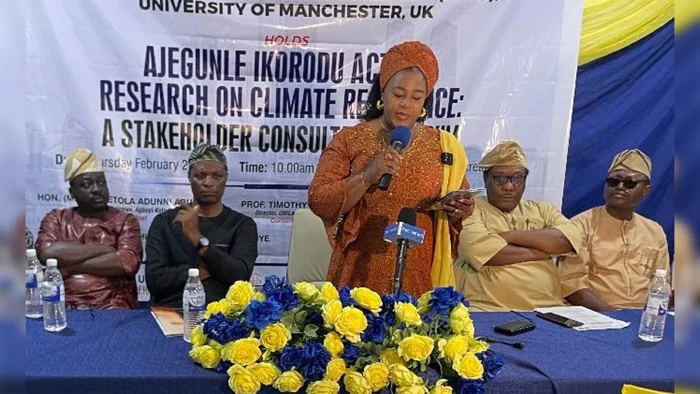
Experts from the Centre for Housing and Sustainable Development (CHSD), University of Lagos (UNILAG), and the African Cities Research Consortium (ACRC) have called for immediate intervention in high-risk, flood-prone communities in Lagos to avert large-scale damage to lives, homes and infrastructure.
The warning was issued during a Stakeholders’ Consultative Forum on the Ajegunle-Ikorodu Action Research on Climate Resilience held at the Agboyi-Ketu Local Council Development Area (LCDA).
Lagos at Growing Risk
Speaking at the forum, CHSD Co-Director and Action Research for Climate Resilience Lead, Peter Elias, revealed that precipitation levels in Lagos are projected to double by 2050. He cautioned that without proactive adaptation measures, rising sea levels could leave nearly 50 per cent of the city underwater by 2100.
Elias explained that while climate change is a global phenomenon that cannot be entirely eliminated, its impacts can be mitigated through forward-looking urban planning and resilient infrastructure.
According to him, vulnerable communities—particularly informal settlements along lagoon and ocean frontiers—face the greatest threat. He noted that Ajegunle-Ikorodu was selected for the research because of its low-lying coastal terrain and escalating rainfall patterns.
“Flooding in the area is not solely linked to rainfall or dam releases but also to ocean surges caused by backflow from the Atlantic Ocean,” Elias said.
44,000 Residents Exposed
The study found that more than 44,000 residents and over 6,000 buildings in Ajegunle-Ikorodu are exposed to flood risks, with the most vulnerable zones located in the lowest-lying sections of the community.
Elias added that rapid urbanisation, inadequate drainage systems and indiscriminate waste disposal have compounded the problem, placing homes, businesses and public infrastructure under increasing strain.
He warned that existing infrastructure design standards are insufficient to withstand projected future climate conditions. Local drainage systems currently built for five- to 10-year storm events, he said, must be upgraded to accommodate 25-year storms under RCP 4.5 and 50-year storms under RCP 8.5 climate scenarios.
“Major drainage channels should be expanded to handle 50- to 100-year design capacity. Roads and culverts require additional freeboard of between 0.5 and 1.0 metres, while critical facilities such as schools and markets must be elevated above projected flood levels,” he stated.
Global Relevance of Local Action
The City Manager of ACRC, Temilade Sesan, highlighted the global importance of the initiative, noting that Lagos is contributing significantly to international discussions on climate-smart urban transformation.
She explained that ACRC adopts a long-term theory-of-change approach, defining future goals and working backwards to determine the steps required today to achieve resilient outcomes.
Council Backs Research-Driven Solutions
Chairman of Agboyi-Ketu LCDA, Adetola Abubakar, described flooding and other climate-related challenges in the area as serious but surmountable.
She commended CHSD and ACRC for pursuing sustainable, research-based interventions and assured stakeholders of the council’s readiness to support implementation of recommended strategies.
Abubakar noted that Agboyi-Ketu is uniquely vulnerable due to its riverine and island geography. The Agboyi I, II and III communities sit within the Lagos Lagoon, while Ajegunle lies along interconnected creeks, increasing exposure to tidal surges and heavy rainfall events.
Toward a Resilient Future
Founding Director of CHSD, Timothy Nubi, described Ajegunle-Ikorodu as highly vulnerable to climate hazards and emphasised that collaboration between research institutions and local authorities is essential to building resilience.
He said the partnership aims to deliver practical, community-based strategies that address both immediate flooding challenges and long-term sustainability.
A community representative, Olawale Oyeneye, who has participated in the research since June 2025, praised the inclusive data-gathering process. He said residents’ involvement has helped identify additional community needs, including improved schools and 24-hour healthcare services.
As climate threats intensify, experts at the forum stressed that timely intervention, infrastructure upgrades and coordinated planning are critical to safeguarding Lagos’ coastal communities and ensuring the city’s long-term resilience.