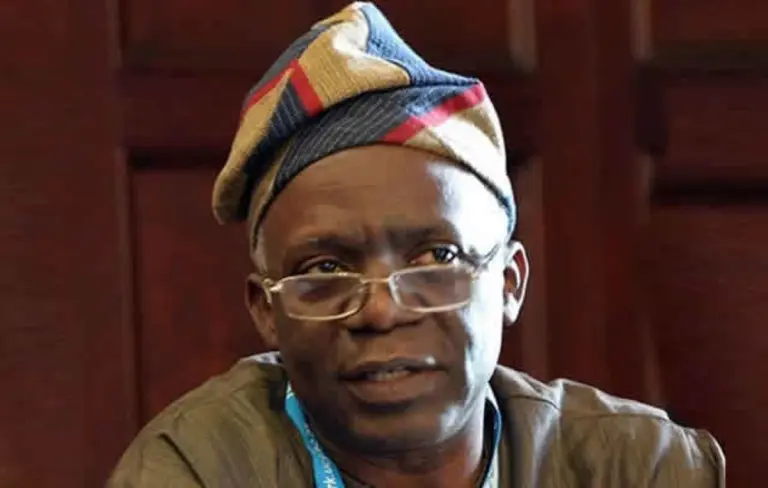
Human rights lawyer and Senior Advocate of Nigeria, Femi Falana, has warned that the rule of law is increasingly under threat in Nigeria, citing recent demolitions in Makoko and Oworonsoki areas of Lagos State as troubling examples.
Falana raised the concern on Saturday in Abeokuta, Ogun State, during the 2025 Annual General Conference of the Committee for the Defence of Human Rights (CDHR). The conference, themed “Advancing and Defending the Rule of Law in Nigeria: Stakeholders’ Tragedy and Way Forward,” brought together civil society leaders, activists, and delegates from across the country.
Speaking through his representative, Malachy Ugwumadu, Falana questioned whether the principles of the rule of law truly operate in Nigeria’s democratic system. He argued that the manner in which the Lagos demolitions were carried out reflects a deeper governance failure, particularly in the protection of vulnerable citizens.
“The question is whether we can boldly say that the rule of law is operational in our country,” Falana said. “If it were, what is happening in Oworonsoki and Makoko in Lagos would not be taking place.”
According to him, thousands of residents have been displaced during demolition exercises, with homes destroyed while occupants, including children, were still inside. He described the situation as a clear violation of basic human rights and due process.
Falana argued that the affected communities largely consist of economically disadvantaged Nigerians, making them easy targets for forceful state actions. He contrasted their treatment with that of residents in more affluent parts of Lagos such as Ikoyi and Ajah.
“The only offence of these people is that they belong to the demographic of weak Nigerians, those who are not financially buoyant,” he said. “Yet, their properties are razed, and their lives disrupted without adequate safeguards.”
The human rights lawyer also expressed concern over the shrinking civic space in Nigeria, particularly the handling of protests and dissent. He noted that activists who challenged the demolitions, including Soweto Hassan and Dele Frank, were allegedly manhandled by security operatives and subsequently charged to court.
According to Falana, such actions discourage lawful protest and erode citizens’ confidence in democratic institutions. He warned that the growing intolerance for dissent mirrors practices associated with military rule rather than civilian democracy.
“Our country appears to be sliding back into a military mentality,” he said. “I do not understand how we have sleep-walked into this situation, where peaceful protest is treated as a crime.”
Falana further accused the government of weaponising existing laws to silence criticism, particularly the Cybercrime Act. He claimed the law is increasingly being used to intimidate journalists and stifle press freedom, rather than protect citizens from genuine cyber threats.
Beyond demolitions and protest suppression, Falana lamented what he described as a widening gap between the rich and the poor. He argued that state policies and enforcement actions are deepening social inequality and weakening already vulnerable communities.
“Our country has always faced challenges, but the current dimension seems to deliberately weaken the poor,” he said. “This only widens the gap between the haves and the have-nots.”
He urged civil society organisations, activists, and human rights defenders not to relent in holding government accountable. According to him, sustained advocacy and collective action remain critical to reversing the erosion of the rule of law.
“We must stand firm and resolute in pursuing the cause we have chosen,” Falana said, calling on stakeholders to remain committed despite increasing pressure.
Also speaking at the conference, the Vice President of the CDHR, Yinka Folarin, acknowledged that defending human rights in Nigeria has become more difficult in recent times. He stressed that democracy cannot thrive without strict adherence to the rule of law.
“Democracy should be premised on the rule of law, and the rule of law must be the cornerstone of any democratic system,” Folarin said. “There is still a lot of work to be done in promoting and respecting human rights in Nigeria.”
The conference ended with renewed calls for stronger institutional safeguards, judicial independence, and greater respect for citizens’ rights, particularly in urban development and security operations. Participants warned that without meaningful reforms, public trust in democratic governance would continue to erode.