Rising tensions in the Middle East are beginning to affect Nigeria’s economy as increasing global crude oil prices push petrol costs higher and trigger fresh increases in transport fares and food prices across the country.
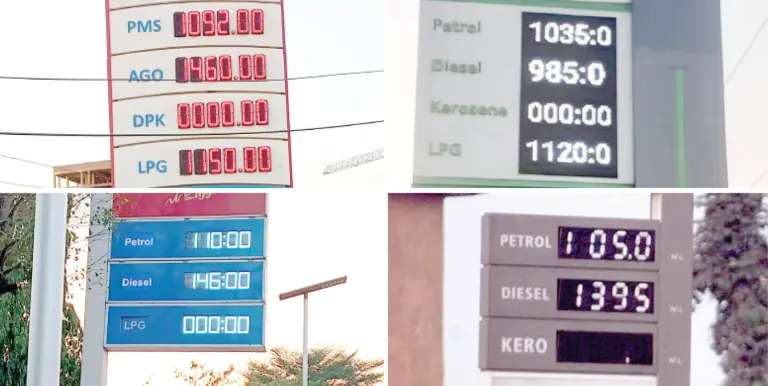
Across major cities including Lagos, Abuja, Kano, Port Harcourt, Kaduna and Yenagoa, motorists and commuters are facing a new round of petrol price adjustments, with the pump price of Premium Motor Spirit (PMS) climbing to between N1,020 and N1,100 per litre at many filling stations.
The development has raised concerns among residents, transport operators and traders who fear the situation could further worsen the cost of living.
Petrol prices rise across major cities
Checks at filling stations in Lagos showed petrol selling between N1,050 and N1,100 per litre depending on the outlet.
Retail stations operated by Northwest Petroleum sell petrol for about N1,050 per litre, while TotalEnergies outlets dispense at around N1,055 per litre.
Stations belonging to MRS Oil Nigeria Plc sell at approximately N1,057 per litre, while some Mobil stations charge as high as N1,100 per litre.
The rising fuel price has already triggered increases in transportation costs.
Ekundayo Oladimeji, a commercial bus driver operating between Ogba and Ikeja in Lagos, said fares had risen from N400 to N500 due to the surge in petrol prices.
“There is no doubt transport fares will increase. We have started charging N500 from Ogba to Ikeja. On Monday it may increase to N700,” he said.
However, some drivers said they were struggling to raise fares due to passengers’ resistance despite higher fuel costs.
Food prices also surge
The rise in petrol prices has also begun affecting food markets as the cost of transporting agricultural produce increases.
Traders in Lagos reported sharp increases in the prices of pepper and tomatoes.
A small bag of pepper now sells for about N82,000 compared to N18,000 previously. A medium bag has risen to about N122,000 from N22,000, while a large bag now sells for about N172,000 compared to around N70,000 earlier.
Tomatoes have also recorded significant increases, with a small bag rising from about N22,000 to roughly N50,000, while a large bag now sells for about N125,000 compared to N62,000 previously.
Residents say the increases are already affecting household budgets.
Oyekale Oluwasegun, a Lagos resident, said the cost of commuting has increased significantly.
“A trip from Powerline to Ogba that used to cost N200 now costs about N300. I already have my monthly budget planned, but this increase has affected it,” he said.
Similar situation across states
In Kano, several filling stations including AY Maikifi, Aliko Oil and AA Rano have increased pump prices from about N980 per litre to between N1,050 and N1,104.
At stations operated by the Nigerian National Petroleum Company Limited (NNPC), petrol sold for as high as N1,084 per litre.
In Abuja, petrol now sells between N1,050 and N1,080 per litre compared to previous prices of about N845 to N875.
In border areas of Ogun State, particularly around Abeokuta, petrol has reportedly risen to between N1,300 and N1,400 per litre.
Residents say transport fares have increased sharply in response.
In Yenagoa and Port Harcourt, petrol prices now range between N970 and N1,050 per litre, pushing up the cost of food items and transportation.
Middle East conflict drives oil price surge
The latest increase in fuel prices coincides with rising global crude oil prices following escalating hostilities involving the United States, Israel and Iran.
The conflict has raised fears of disruptions in oil supply from the Middle East, one of the world’s most important energy-producing regions.
Global crude oil prices have risen to about $93 per barrel from around $69 at the start of the conflict.
Analysts warn that prices could climb as high as $130 per barrel if tensions continue to escalate.
Dangote refinery adjusts price
Dangote Refinery recently increased its ex-depot price of petrol to N995 per litre from N874 in response to the rising cost of crude oil.
The company explained that while it receives some crude oil supplies paid for in naira, the volume is insufficient to meet its monthly demand.
According to the refinery, it receives about five cargoes of crude monthly but requires 13 cargoes to meet domestic production needs.
The remaining supply is sourced from local and international traders at international market prices, which are paid for using foreign exchange.
Expert warns Nigerians to prepare for higher costs
An economist and oil and gas analyst, Dr Marcel Okeke, warned that Nigerians should prepare for further increases in fuel prices and inflation if the Middle East conflict continues.
According to him, rising global crude oil prices quickly translate into higher petrol prices in Nigeria due to the country’s reliance on imported petroleum products and international pricing benchmarks.
“When the price of fuel goes up, it immediately affects transportation costs, food prices and logistics. This will ultimately lead to higher inflation,” he said.
Market forces driving pump prices
The Nigerian Midstream and Downstream Petroleum Regulatory Authority (NMDPRA) said the recent fuel price fluctuations are a result of market forces in Nigeria’s deregulated petroleum sector.
Spokesperson of the agency, George Ene-Ita, explained that pump prices now respond directly to supply and demand conditions.
According to him, the deregulated framework allows market forces to determine fuel prices while encouraging competition and investment in the downstream oil sector.