


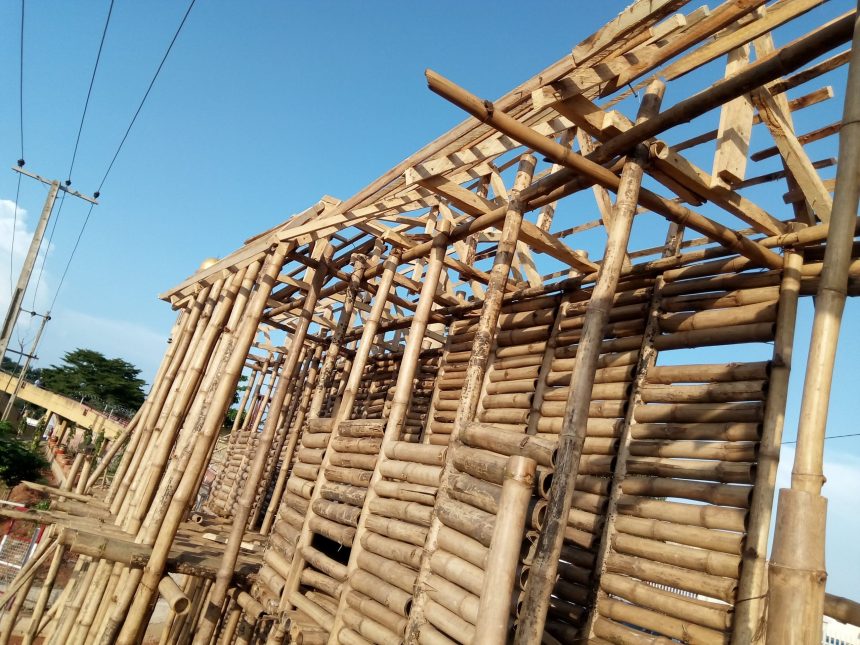
The Federal Government’s renewed push to close Nigeria’s estimated 22 million housing deficit using affordable, climate-smart homes built with bamboo has revived long-standing concerns about the absence of clear standards and regulations for alternative building materials.
At a capacity-building workshop in Abuja, the Permanent Secretary of the Federal Ministry of Innovation, Science and Technology, Mrs. Esuabana Asanye, said bamboo could become a key material for low- and middle-income housing.
She explained that widespread adoption of engineered bamboo would support environmental sustainability, reduce construction costs, and ease dependence on imported materials.
According to her, bamboo—when combined with other verified technologies—offers a scalable solution for Nigeria’s fast-growing population without harming the environment. She added that using bamboo aligns with the Federal Government’s climate-smart housing vision and complements research innovations championed by the Nigerian Building and Road Research Institute (NBRRI).
Nigeria’s Tough Housing Reality
Housing shortages continue to worsen across major Nigerian cities, driven by rapid urbanisation, high construction costs, limited mortgage access, widespread poverty, and poor infrastructure. With two-bedroom apartments selling between ₦62 million and ₦180 million, many citizens cannot afford decent homes.
Rising prices of cement, iron rods, sand, roofing sheets, and timber have forced some developers to abandon projects, while millions of Nigerians now live in informal settlements or unfinished buildings.
Why Bamboo Is Gaining Attention
Bamboo grows abundantly in Nigeria—especially in the South-East, South-South, and Middle Belt—and takes just three to five years to reach structural maturity, unlike hardwoods that require decades. Properly treated bamboo can match timber in strength and out-perform many traditional materials on cost, renewability, and carbon footprint.
Globally, countries like Colombia, Costa Rica, Indonesia, the Philippines, China, and India have successfully used engineered bamboo for modern homes, schools, and community buildings.
Despite this potential, bamboo adoption in Africa remains modest, with only Ethiopia, Ghana, and Kenya running small-scale pilots. Experts say Nigeria has the natural advantage to lead the continent—if it develops the right policies and technical standards.
Stakeholders Cautious on Large-Scale Adoption
In Nigeria, bamboo is widely used for scaffolding, with over 81% of contractors relying on it. Yet, there are no formal technical guidelines or safety codes, meaning most scaffolds are built using guesswork, often leading to avoidable worksite accidents.
Industry experts warn that rolling out bamboo housing at scale will require:
-
nationwide plantations of mature bamboo
-
treatment standards for durability
-
inclusion in Nigeria’s building codes
-
extensive testing and prototypes
-
public education to address perception issues
Former President of the Nigerian Institution of Structural Engineers, Dr. Victor Oyenuga, said large-scale use would only succeed if supply, cost, structural integrity, and treatment processes are properly defined.
A former President of the Nigerian Institute of Building, Kunle Awobodu, expressed concern that Nigeria has a history of abandoning innovative building technologies after initial enthusiasm, citing failures with stabilised clay blocks.
Perception and Awareness Still a Barrier
Former NIA President, Festus Adibe, noted that many Nigerians still associate bamboo with inferior or rural structures. He stressed that modern engineering allows bamboo to be split, laminated, and reinforced without compromising aesthetics or strength.
A Hopeful Path Forward
Architecture professor Erekpitan Ola-Adisa believes bamboo offers Nigeria a realistic path to solving its housing and environmental crises simultaneously. To achieve this, she recommended:
-
integrating bamboo into architectural education
-
showcasing well-designed bamboo buildings
-
supporting local artisans
-
building public trust through research and prototypes
-
promoting bamboo’s low-carbon footprint
She said bamboo could redefine Nigeria’s architectural identity if cultural, regulatory, and technical barriers are addressed.
