


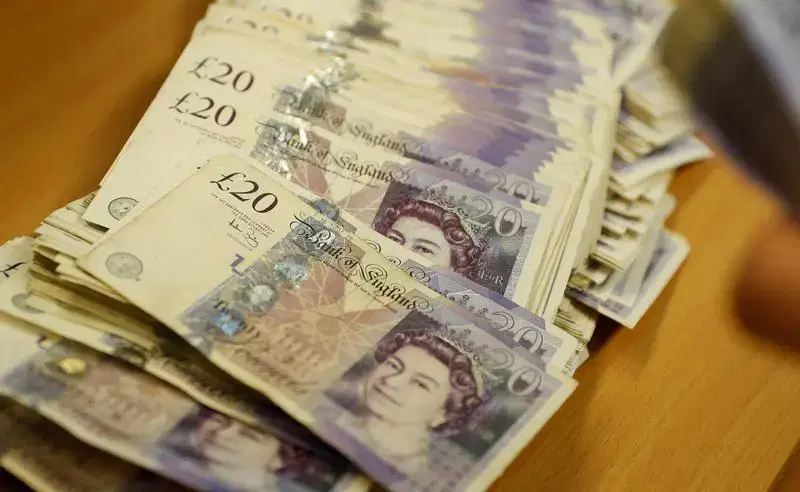
The British Pound recorded a marginal decline against the Nigerian Naira in early trading on Friday, February 27, 2026, as improved foreign exchange liquidity and rising external reserves supported the local currency.
Data from the Nigerian Foreign Exchange Market (NFEM) indicates that the Naira maintained relative stability at the official window, while the gap between official and parallel market rates remained narrow.
Official Market Performance
At the official window, the Naira opened at approximately ₦1,828.32 per Pound. During early trading hours, the exchange rate appreciated slightly, with the Pound easing to ₦1,826.63 by 6:00 a.m. WAT.
This movement follows a volatile midweek session in which the Naira had briefly weakened to ₦1,834.96 per Pound before regaining ground.
Related Posts:
Market analysts attribute the relative calm to strategic interventions by the Central Bank of Nigeria (CBN), which has continued to manage liquidity in both dollar and sterling segments of the market.
The apex bank recently reduced its benchmark interest rate by 50 basis points to 26.50 per cent, signalling the beginning of a cautious, data-dependent monetary easing cycle. The move followed a moderation in inflation to 15.10 per cent in January 2026, strengthening confidence in macroeconomic stability.
Parallel Market Trends
In the parallel market, commonly referred to as the black market, the Pound Sterling traded within a range of ₦1,840 to ₦1,855 per Pound on Friday morning.
Although the informal sector continues to cater to retail demand for travel allowances, school fees and personal remittances, traders in Lagos and Abuja reported reduced speculative demand compared to previous years.
The relatively tight spread between the official and parallel market rates reflects improved foreign exchange supply conditions and renewed participation of Bureau De Change (BDC) operators in the formal distribution framework.
Currency dealers noted that demand for Pounds remains steady due to ongoing tuition payments to the United Kingdom and settlement of international service contracts. However, the panic-driven purchases that previously widened exchange rate gaps have largely subsided.
Key Factors Supporting the Naira
Several macroeconomic developments are shaping the Pound to Naira trajectory this week.
1. Rising External Reserves
Nigeria’s external reserves have climbed to $50.45 billion, marking a 13-year high. The strong reserve position has boosted investor confidence in the CBN’s capacity to defend the Naira against external shocks and speculative pressures.
Higher reserves provide the central bank with a larger buffer to intervene in the foreign exchange market when necessary, helping to smooth volatility.
2. Monetary Policy Adjustment
The recent rate cut by the Central Bank of Nigeria reflects a gradual shift toward supporting economic growth as inflation shows signs of easing.
While lower interest rates can sometimes weaken a currency by reducing yield attractiveness, analysts say the impact has been offset by improved dollar inflows and better reserve management.
3. Improved Oil Production and FX Supply
Nigeria’s domestic oil production has shown signs of improvement in recent months, contributing to stronger export earnings. Reduced reliance on foreign refined petroleum imports has also lowered pressure on foreign exchange demand.
These developments have helped stabilise the Naira despite broader global currency fluctuations.
Global Influences
On the global stage, the British Pound remains supported by steady economic data from the United Kingdom, including resilient consumer demand and stable labour market conditions.
However, gains against the Naira have been limited by Nigeria’s strengthening domestic fundamentals and proactive foreign exchange management.
Currency analysts note that the GBP/NGN pair remains sensitive to global risk sentiment, particularly movements in the U.S. dollar and shifts in commodity prices.
Short-Term Outlook
As the trading week draws to a close, market observers expect the Pound to Naira exchange rate to fluctuate within the ₦1,820 to ₦1,835 range in the official market, barring unexpected external shocks.
In the parallel market, rates are likely to remain slightly elevated but relatively aligned with official pricing, provided liquidity conditions remain stable.
Overall, the narrowing gap between official and informal rates signals improved market confidence and reduced speculative pressures.
For businesses, importers and individuals with Pound-denominated obligations, the current environment suggests short-term stability, although traders continue to monitor global developments and domestic policy signals closely.
The coming weeks will determine whether sustained reserve growth and disciplined monetary management can anchor the Naira further — or whether renewed global volatility could test the central bank’s resolve.